Turn on cookies to sign in
Signing in saves your progress to your Curie account. We can only do that with cookies on — turn them on to continue.
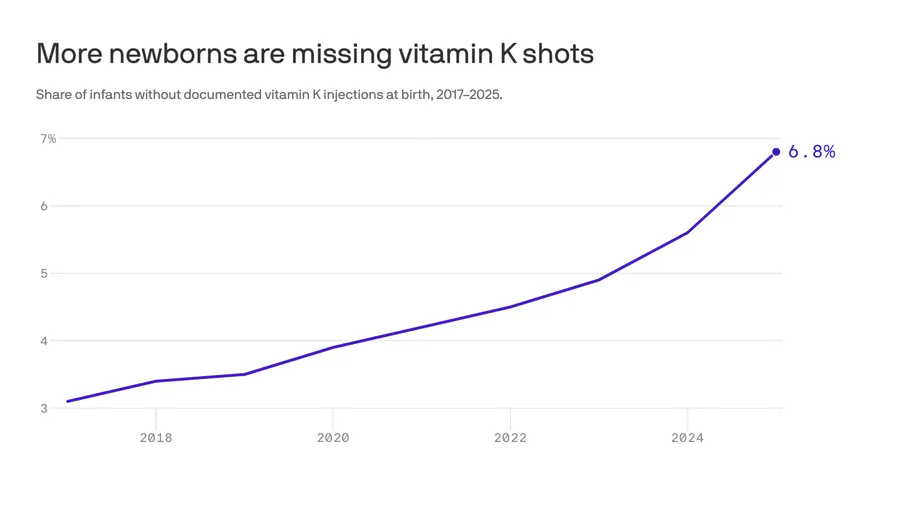
Fewer newborns are getting the routine vitamin K shot — and babies are paying the price. Two new JAMA studies found that the share of infants missing the shot more than doubled from 2017 to 2025, while diagnoses of vitamin K deficiency bleeding quadrupled over the same period. Researchers point to social media misinformation as a key driver of parental hesitancy.
Fewer newborns are getting the routine vitamin K shot — and babies are paying the price. Two new studies published in JAMA and JAMA Pediatrics reveal a troubling trend: the share of U.S. infants not receiving the shot more than doubled between 2017 and 2025, while diagnoses of vitamin K deficiency bleeding surged. Researchers say social media misinformation about the shot's safety is fueling parental hesitancy, with many parents viewing it as an unnecessary medical intervention.
The vitamin K shot — recommended by the American Academy of Pediatrics since 1961 — is a simple preventive measure against potentially life-threatening bleeding, including brain bleeds. Researchers warn that the condition it prevents has become so rare, largely because of the shot, that parents now underestimate the real risk — a phenomenon they describe as being a "victim of its own success."
By the Numbers:
Why it matters: Skipping this one shot can lead to severe, potentially fatal complications requiring intensive medical care. Clinicians are now watching closely to see whether this hesitancy spreads to other routine newborn interventions, like the hepatitis B vaccine.