Turn on cookies to sign in
Signing in saves your progress to your Curie account. We can only do that with cookies on — turn them on to continue.
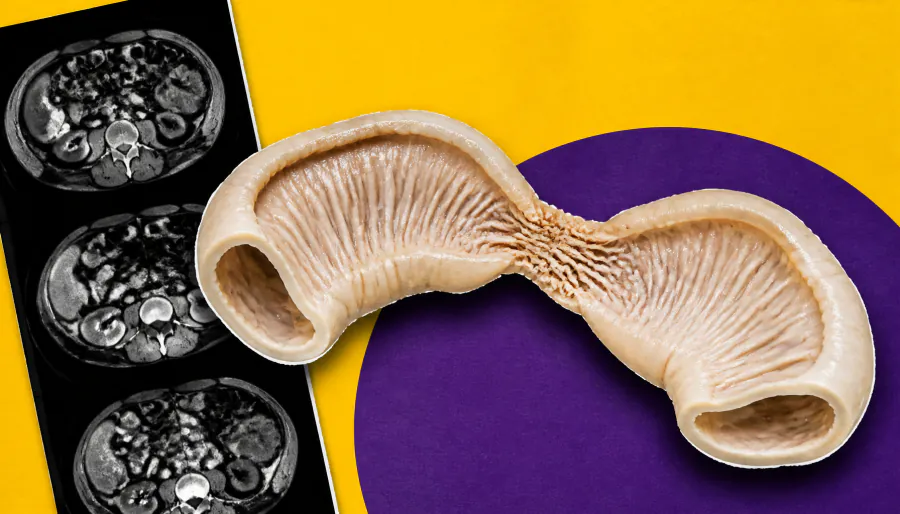
A new MRI-based scoring tool can predict which Crohn's disease strictures are unlikely to improve after advanced therapy. The composite framework — combining activity and structural imaging features — outperformed existing scoring systems with an impressive AUC of 0.90. This could help clinicians better risk-stratify patients before committing to a treatment plan.
Researchers have developed and validated a magnetic resonance enterography (MRE)-based scoring framework that can predict whether Crohn's disease (CD) strictures will persist after advanced therapy — giving clinicians a powerful new tool for treatment planning. The study, published in Clinical Gastroenterology and Hepatology, analyzed data from nearly 200 patients across two time-separated cohorts.
The framework uses two composite scores: an A-score (based on activity features like bowel wall thickness, ulceration, and comb sign) and a P-score (based on structural features like stricture length, prestenotic bowel diameter, and absence of intramural edema). Together, they outperformed existing MRI-based scoring tools in predicting stricture nonimprovement.
By the Numbers:
Why it matters: Most Crohn's strictures don't improve with advanced therapy alone, and identifying which ones are most likely to persist could help clinicians make earlier, more informed decisions — potentially avoiding delayed surgical intervention or unnecessary treatment escalation.