Turn on cookies to sign in
Signing in saves your progress to your Curie account. We can only do that with cookies on — turn them on to continue.
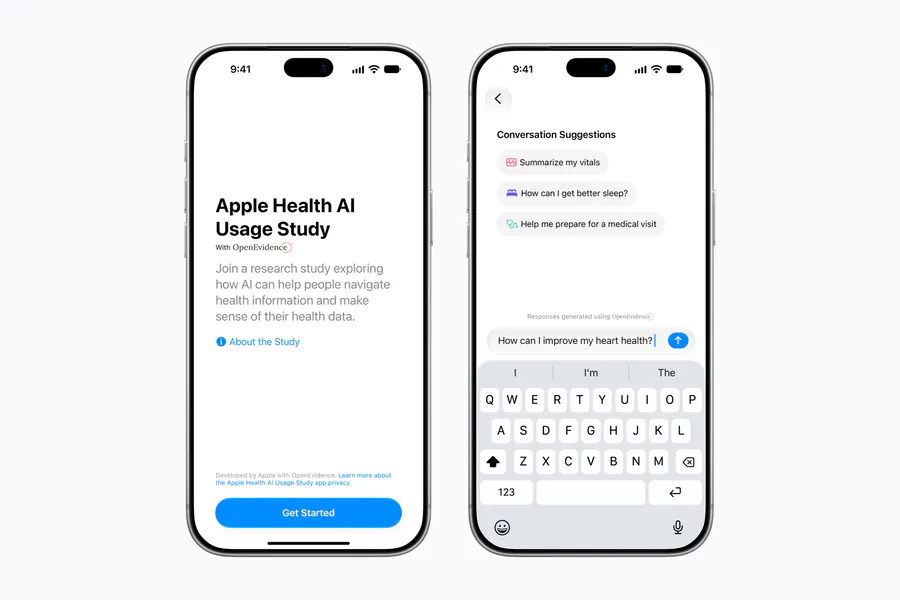
Apple is recruiting 200,000 U.S. participants for its Health AI Usage Study to understand how people interact with AI-powered health tools. Partnering with clinical AI startup OpenEvidence, the study will examine user trust, comprehension, and whether AI chatbots improve doctor-patient interactions. Study data will not be used to train AI models.
Apple is going big on health AI research. The tech giant has launched the Apple Health AI Usage Study, aiming to recruit 200,000 U.S. adults to better understand how people engage with conversational AI health tools. The 12-month virtual study is built on a dedicated app and powered by OpenEvidence, a clinical AI platform that draws from peer-reviewed sources including NEJM, JAMA, and Cochrane. Participants can ask health questions, rate AI responses, and optionally share HealthKit and clinical data for more personalized insights.
The study comes at a pivotal moment: roughly 1 in 3 U.S. adults already turn to AI chatbots for health information, yet research shows a significant gap between AI accuracy and patients' ability to safely act on that information. Apple wants to close that gap by studying what drives trust, comprehension, and real-world health behavior changes.
By the Numbers:
Why it matters: As health AI becomes mainstream, rigorous research on how patients actually use and understand it is critical. Apple's study could shape industry-wide standards for responsible, trustworthy health AI design — and help bridge the gap between patients and their doctors.