Turn on cookies to sign in
Signing in saves your progress to your Curie account. We can only do that with cookies on — turn them on to continue.
The EPIC17-VERONICA trial found that using platelet function testing (PFT) to guide antiplatelet therapy de-escalation after PCI for ACS did not reduce adverse events over 11 months. The trial was underpowered due to fewer-than-expected events, making findings hypothesis-generating only. Experts remain divided on whether PFT still has a role in select clinical scenarios.
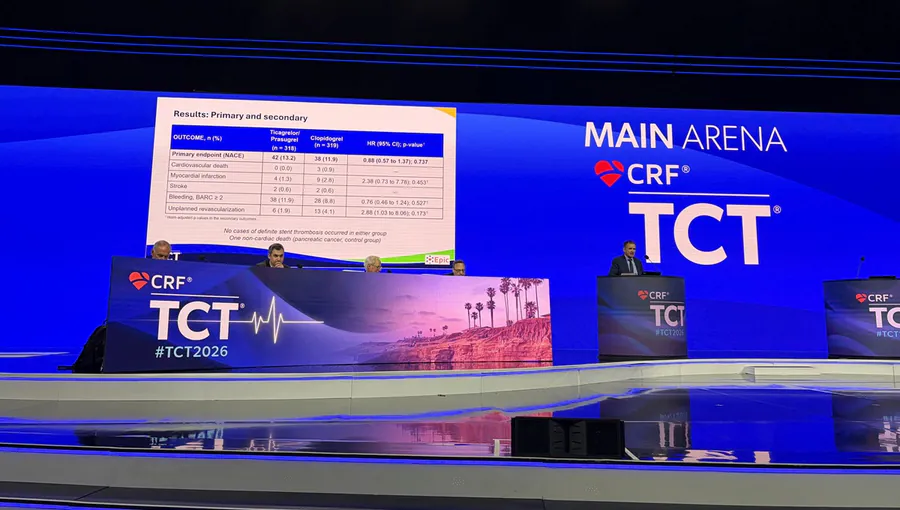
The EPIC17-VERONICA trial, presented at TCT 2026, found that using platelet function testing (PFT) to guide dual antiplatelet therapy (DAPT) de-escalation after percutaneous coronary intervention (PCI) for acute coronary syndrome (ACS) did not reduce net adverse clinical events (NACE) compared to continuing potent P2Y12 inhibitor therapy. The trial randomized 637 patients with low platelet reactivity at 30–40 days post-PCI to either continue a potent P2Y12 inhibitor or de-escalate to clopidogrel, with follow-up through 11 months.
The primary endpoint — a composite of cardiovascular death, nonfatal MI, nonfatal stroke, and significant bleeding — was similar between groups (13.2% vs. 11.9%). The trial was underpowered, as event rates were lower than anticipated, making the results hypothesis-generating rather than definitive.
Key Takeaways:
Why it matters: With unguided DAPT de-escalation already validated across multiple trials, EPIC17-VERONICA adds to growing skepticism about routine PFT-guided strategies — though select clinical scenarios may still warrant its use.