Turn on cookies to sign in
Signing in saves your progress to your Curie account. We can only do that with cookies on — turn them on to continue.
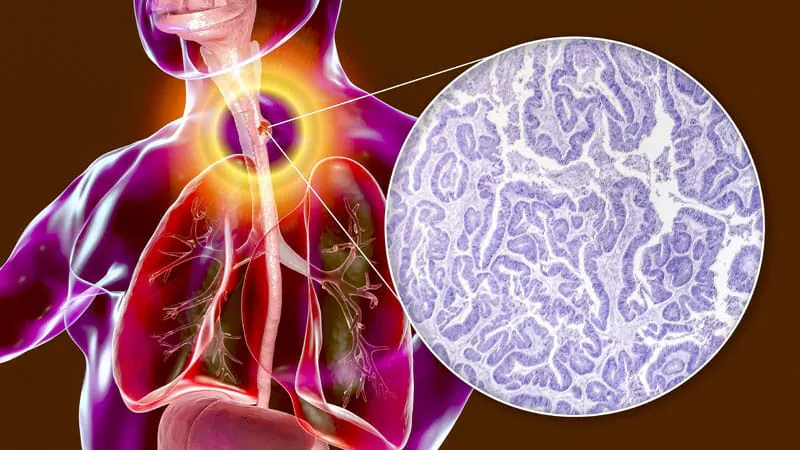
Active surveillance after chemoradiation matches surgery's 5-year survival in esophageal cancer, but with trade-offs. The phase 3 SANO trial found similar overall survival rates between the two approaches, though distant metastases and cancer-specific deaths were notably higher in the surveillance group. Experts say the strategy may work for select patients at high-volume centers — but it's not a one-size-fits-all solution.
For patients with locally advanced esophageal cancer who achieve a complete clinical response after chemoradiation, skipping immediate surgery might not cost them their lives — at least not in the short term. Updated 5-year data from the phase 3 SANO trial, presented at ESMO 2026, showed that active surveillance produced a similar overall survival rate as standard esophagectomy (50% vs. 54%), with no statistically significant difference in disease-free survival either.
But it's not all good news. The surveillance group saw significantly more distant metastases and higher rates of esophageal cancer-specific deaths, raising real questions about long-term oncological safety. On the flip side, 43% of surveillance patients were spared esophagectomy entirely — a procedure notorious for its complications and quality-of-life impact. Experts caution that "similar survival" doesn't equal "similar disease control."
Key Takeaways:
Why it matters: Active surveillance could offer a meaningful quality-of-life benefit for carefully chosen patients, but the higher metastasis and cancer-death rates mean it's not ready for broad adoption. For now, experts recommend limiting this approach to experienced, high-volume centers with rigorous monitoring protocols.