Turn on cookies to sign in
Signing in saves your progress to your Curie account. We can only do that with cookies on — turn them on to continue.
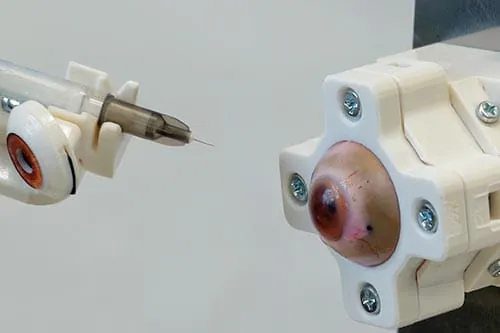
A Swiss research team has performed the world's first autonomous robotic intravitreal injection into a human donor eye, outperforming human injectors in speed, precision, and consistency. The robot responded to unexpected eye movements 20 times faster than a human and hit injection targets within 50 micrometers. The team hopes to move toward live-patient use, pending FDA approval and further safety integrations.
A team at ETH Zürich, in collaboration with ophthalmologists from Augenklinik Zürich West and the University of Zürich, has achieved a world first: an autonomous robot performing an intravitreal injection into a human donor eye. Presented at EURETINA 2026, the findings show the robot outperformed human injectors on safety, injection location precision, and volume accuracy — all while keeping a surgeon in the loop to monitor and control the procedure.
The technology was born out of a very real clinical pressure: ophthalmologists are performing thousands of retinal injections annually, with shrinking reimbursements and growing patient demand. The robot's consistency — delivering the same quality injection regardless of time of day or operator fatigue — is a key selling point. Researchers also envision remote operation capabilities that could bring retinal care to rural and underserved communities.
By the Numbers:
Why it matters: With retinal disease on the rise globally, a reliable, precise robotic injector could ease the burden on ophthalmologists, reduce human error, and expand access to care — though FDA approval and patient acceptance remain key hurdles ahead.