Turn on cookies to sign in
Signing in saves your progress to your Curie account. We can only do that with cookies on — turn them on to continue.
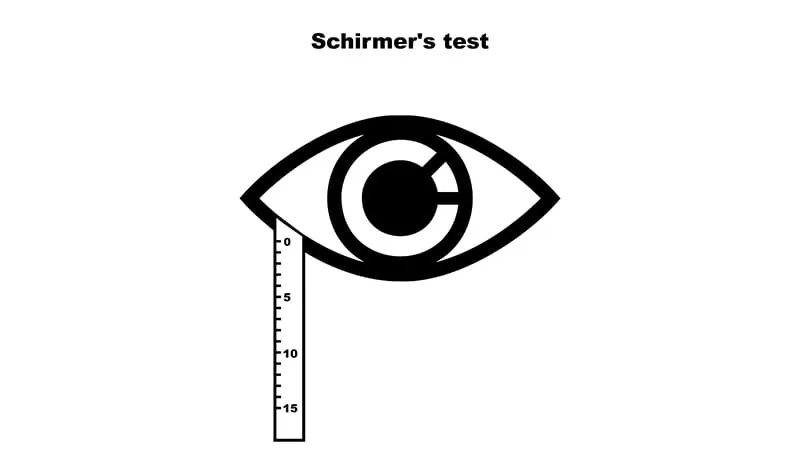
A widely used dry eye test is underperforming in Sjögren disease diagnosis. New research shows the Schirmer test has a sensitivity below 50% for Sjögren dry eye disease, far behind the ocular staining score (OSS), which hit over 91% sensitivity. But the test strips may still prove valuable — as a tool for identifying distinct Sjögren disease subtypes through tear protein analysis.
A head-to-head comparison of four dry eye tests has revealed a significant gap in diagnostic performance. Presented at the 17th International Symposium on Sjögren's Disease in Paris, the study found that the Schirmer test had a sensitivity below 50% for Sjögren dry eye disease, while the ocular staining score (OSS) achieved over 91% sensitivity and 83% specificity. Even fluorescein staining alone — just one component of the OSS — outperformed the Schirmer test, with 82.6% sensitivity and 88.8% specificity.
Researchers analyzed data from 3,514 participants in the SICCA cohort using latent class analysis. The findings suggest the current ACR/EULAR diagnostic criteria, which give equal weight to OSS and the Schirmer test, may need to be rebalanced in favor of OSS.
By the Numbers:
Why it matters: With disease-modifying drugs for Sjögren potentially arriving as early as next year, early and accurate diagnosis is more critical than ever. Beyond diagnostics, Schirmer strips may unlock a new frontier — researchers are analyzing the tear proteome and immunoproteome from stored strips to identify distinct Sjögren endotypes, which could eventually guide personalized treatment strategies.