Curie Brief
Turn on cookies to sign in
Signing in saves your progress to your Curie account. We can only do that with cookies on — turn them on to continue.
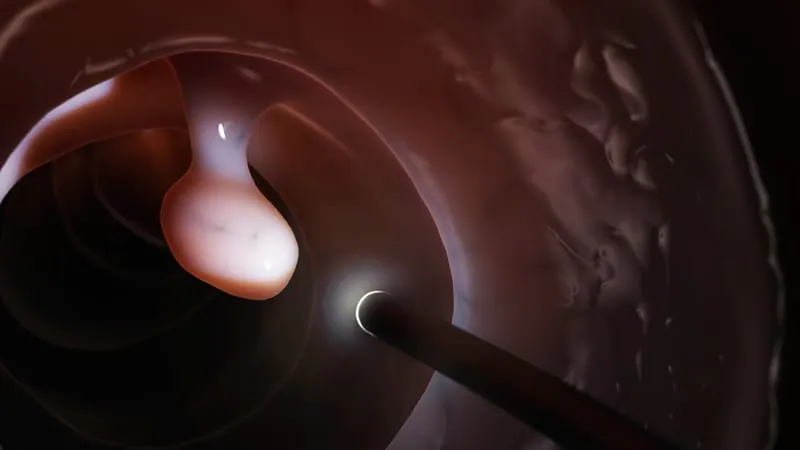
A new twist on a tricky procedure: filling the colon with water instead of gas during endoscopic submucosal dissection (ESD) matched conventional results while cutting procedure time and reducing bleeding. A multicenter Italian trial found underwater ESD (U-ESD) was noninferior for en bloc resection of colorectal lesions, with significantly less smoke interference and faster dissection speeds — making it a compelling option for endoscopists.
A multicenter Italian randomized trial presented at UEG Week 2026 found that underwater endoscopic submucosal dissection (U-ESD) — which fills the colon with water instead of gas — is just as effective as conventional gas-assisted ESD (G-ESD) for removing colorectal lesions, while offering meaningful procedural advantages. The study randomized 295 patients across five tertiary centers, with lesions averaging ~49 mm in size.
Water's buoyancy naturally lifts the lesion, acts as a lens to improve magnification, and dissipates heat to reduce thermal injury risk. It also eliminates much of the smoke that can cloud the operating field during gas-based procedures — a notable benefit for visibility.
By the Numbers:
Why it matters: ESD is already one of endoscopy's most technically demanding procedures. U-ESD doesn't lower the bar — it just makes the climb a little easier, with faster dissection, less bleeding, and dramatically better visibility. For high-volume centers tackling complex colorectal lesions, this approach shows real promise.