Curie Brief
Turn on cookies to sign in
Signing in saves your progress to your Curie account. We can only do that with cookies on — turn them on to continue.
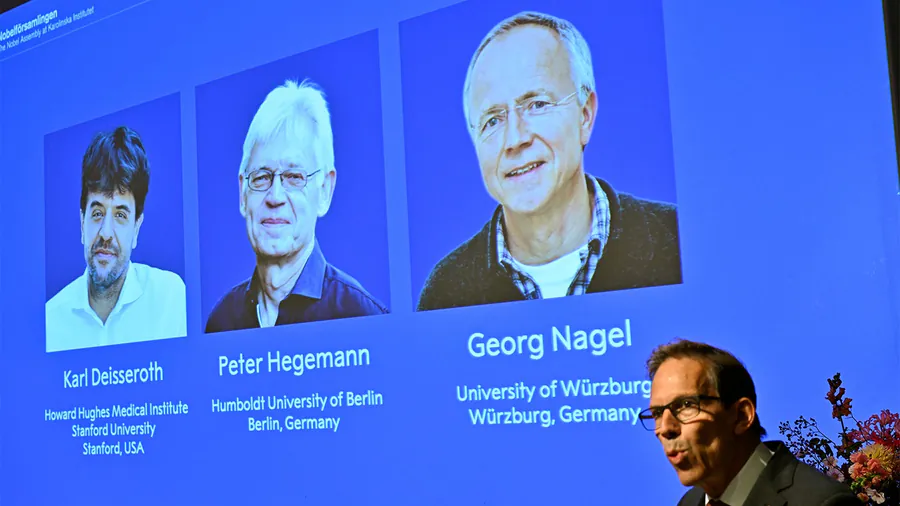
Three scientists win the Nobel Prize in Medicine for optogenetics, a technique that uses light to switch individual nerve cells on and off. Karl Deisseroth, Peter Hegemann, and Georg Nagel share the $1.2 million prize for work that has unlocked new ways to study the brain — and is already being tested as a treatment for blindness, depression, and more.
The 2026 Nobel Prize in Physiology or Medicine went to Karl Deisseroth (Stanford), Peter Hegemann (Humboldt University), and Georg Nagel (University of Würzburg) for their pioneering work on optogenetics — a technique that uses light to precisely control individual nerve cells in a living brain. The Nobel Assembly called it the dawn of "a new era in neuroscience."
The breakthrough traces back to Hegemann's curiosity about how single-celled green algae swim toward light. He and Nagel identified a protein — channelrhodopsin-2 — that opens an ion channel when hit with blue light, generating an electrical impulse. Deisseroth then harnessed the gene controlling that protein to create a light-controlled switch for neurons in living mice, with the method formally named "optogenetics" in 2006. Beyond the lab, the technique is already being applied clinically — most notably to partially restore vision in patients with retinitis pigmentosa. Researchers are also using it to study schizophrenia, Alzheimer's, Parkinson's, epilepsy, and addiction.
By the Numbers:
Why it matters: Optogenetics gives scientists an unprecedented, precise way to probe which brain circuits drive behavior and disease — something nearly impossible with prior tools. With clinical applications underway for vision restoration and therapies for autism in development, this Nobel-winning science is moving from bench to bedside faster than many expected.