Curie Brief
Turn on cookies to sign in
Signing in saves your progress to your Curie account. We can only do that with cookies on — turn them on to continue.
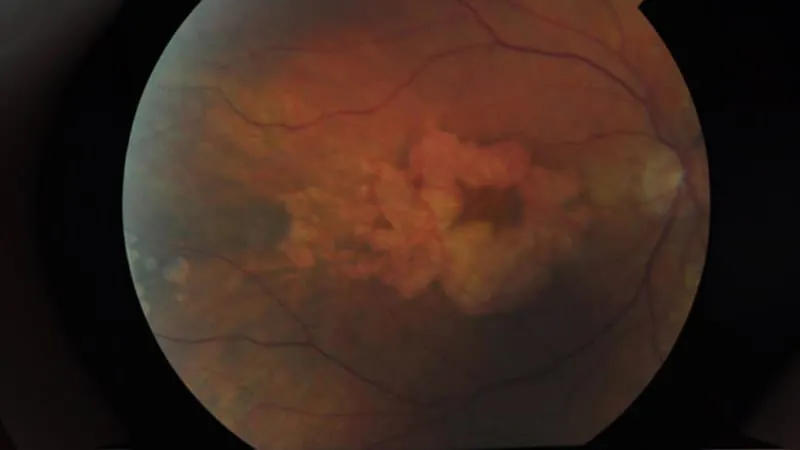
Five-year data confirm that starting pegcetacoplan (Syfovre) earlier in geographic atrophy preserves significantly more retinal tissue than delayed treatment. Patients who began therapy right away retained nearly twice as much retina as those who waited two years. The findings strengthen the case for early intervention, though the drug slows — not stops — disease progression.
Five years of pooled data from the OAKS, DERBY, and GALE trials show that pegcetacoplan (Syfovre) meaningfully slows the growth of geographic atrophy (GA), the advanced form of dry age-related macular degeneration — and that starting treatment earlier makes a real difference. Patients with non-subfoveal GA who began treatment immediately preserved 3.9 mm² of retinal tissue, compared to just 1.9 mm² in those who waited two years before crossing over to the drug — a gap researchers estimate translates to roughly 16.5–18.5 extra months of delayed disease progression.
Experts are encouraged but urge realistic expectations. The drug slows lesion growth; it doesn't stop or reverse vision loss. Once retinal tissue is gone, it can't be recovered — making the timing of treatment initiation critical, especially before lesions reach the foveal center.
Key Takeaways:
Why it matters: GA affects millions of older adults and causes irreversible central vision loss. These long-term data reinforce that earlier treatment initiation — ideally before foveal involvement — offers the greatest benefit, giving clinicians a stronger evidence base for timely conversations with patients about starting therapy.