Curie Brief
Turn on cookies to sign in
Signing in saves your progress to your Curie account. We can only do that with cookies on — turn them on to continue.
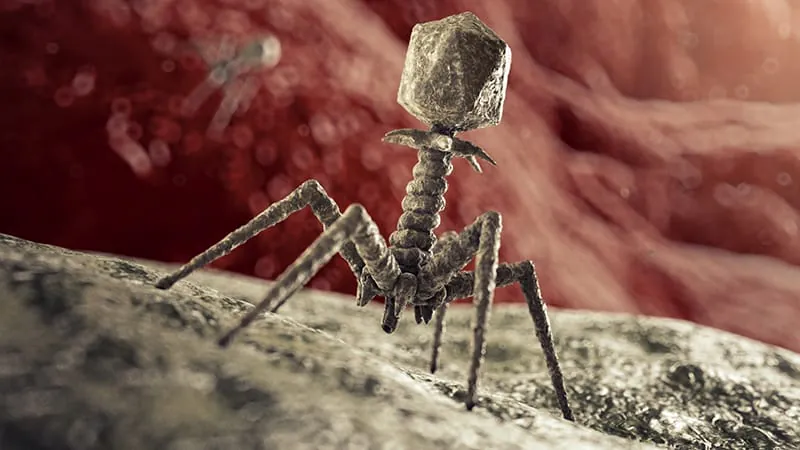
Researchers have cracked a key mystery in phage therapy — why some bacteriophages can kill multiple bacterial strains while others can't. The answer lies in the structural diversity of their tail fibers. This discovery could fast-track the development of broader-spectrum phage treatments for drug-resistant infections, offering a much-needed alternative to failing antibiotics.
Bacteriophages — viruses that hunt and kill bacteria — have long been seen as a promising weapon against antibiotic-resistant infections. But there's a catch: most phages are highly selective, targeting only one bacterial strain. Now, researchers from McMaster University have figured out what makes some phages broader hunters, and it comes down to the shape of their tails.
Published in PNAS, the study analyzed over 1,300 strains of Pseudomonas aeruginosa — a hospital-acquired pathogen increasingly resistant to nearly all antibiotics — and identified 53 distinct variants of the bacterial fibers (pili) that phages latch onto. Broader-spectrum phages had more structural diversity at the tail fiber contact point, allowing them to tolerate variation in bacterial targets. Narrow-spectrum phages, by contrast, lost infectivity with even minor changes in pili structure.
Key Takeaways:
Why it matters: With antibiotic-resistant infections killing millions annually, phage therapy represents one of the most viable alternatives to conventional antibiotics. This structural insight could shift phage selection from trial-and-error to a more predictive, targeted approach — making treatment faster and more accessible for patients with few remaining options.