Curie Brief
Turn on cookies to sign in
Signing in saves your progress to your Curie account. We can only do that with cookies on — turn them on to continue.
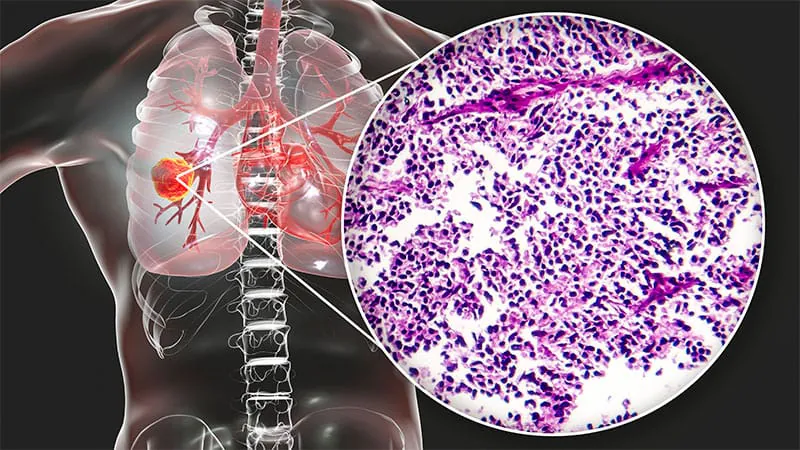
Two B7-H3-targeting antibody-drug conjugates — tambotatug pelitecan and risvutatug rezetecan — each slashed the risk of death by 54% compared to standard topotecan in patients with relapsed small-cell lung cancer. Phase 3 trial results, including a simultaneous NEJM publication, show dramatic improvements in survival and tumor response. Experts say a new second-line treatment standard is emerging for this notoriously difficult-to-treat cancer.
Small-cell lung cancer (SCLC) has long been one of oncology's toughest challenges, with limited options after first-line treatment fails. That may be about to change. Two phase 3 trials — TAISHAN-302 and ARTEMIS-008 — presented at the 2026 World Conference on Lung Cancer in Seoul and published simultaneously in the New England Journal of Medicine, show that B7-H3-targeting antibody-drug conjugates (ADCs) dramatically outperform topotecan, the long-standing second-line standard.
Tambotatug pelitecan (Tam-Peli) cut the risk of death by 54% vs. topotecan, while risvutatug rezetecan (Ris-Rez) matched that same 54% reduction with an even longer median overall survival of 18.5 months. Both agents also showed meaningful activity against brain metastases and were better tolerated than topotecan overall — though interstitial lung disease/pneumonitis emerged as a key toxicity to monitor. Experts caution that both trials were conducted exclusively in China, which may limit generalizability to Western populations.
By the Numbers:
Why it matters: With a third B7-H3 ADC (ifinatamab deruxtecan) already under FDA priority review, the relapsed SCLC treatment landscape is shifting fast. Clinicians may soon have multiple potent new options where there were virtually none before.