Curie Brief
Turn on cookies to sign in
Signing in saves your progress to your Curie account. We can only do that with cookies on — turn them on to continue.
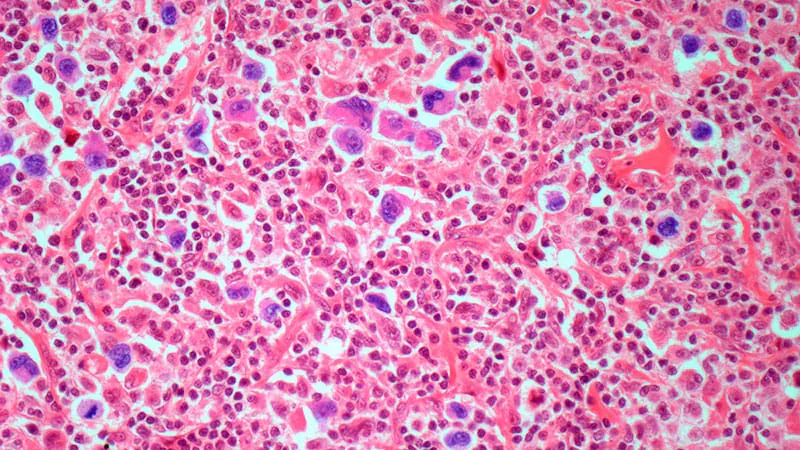
A PET-adapted treatment approach combining nivolumab with intensive chemotherapy achieved a 100% complete metabolic response rate in patients with advanced-stage classical Hodgkin lymphoma by end of therapy. In the phase 2 FINISH-HL trial, 83% of patients hit complete metabolic response after just two induction cycles — and no patient needed radiotherapy. Longer follow-up is still needed to confirm durability.
A PET-guided, response-adapted strategy using nivolumab plus chemotherapy is showing strong early results in advanced-stage classical Hodgkin lymphoma. In the phase 2 FINISH-HL trial, 43 previously untreated patients received nivolumab with an intensive modified BEACOPP-14 regimen (N40-EACOPD-14) for two induction cycles, followed by PET assessment. Those achieving a complete metabolic response (CMR) de-escalated to nivolumab-AVD, while partial responders continued the intensive regimen for up to six cycles.
By end of treatment, all 35 evaluable patients achieved a CMR — and critically, not a single patient required radiotherapy. The safety profile was manageable, with grade 3–4 neutropenia in 17%, febrile neutropenia in 10%, and grade 3 immune-related adverse events in 8%, none requiring nivolumab discontinuation.
By the Numbers:
Why it matters: This trial suggests PET scanning can still meaningfully guide treatment decisions even in the checkpoint inhibitor era — a question that has loomed large as immunotherapy reshapes frontline Hodgkin lymphoma care. However, experts caution that longer follow-up (12–24 months of PFS data) is needed before this approach can be broadly adopted.