


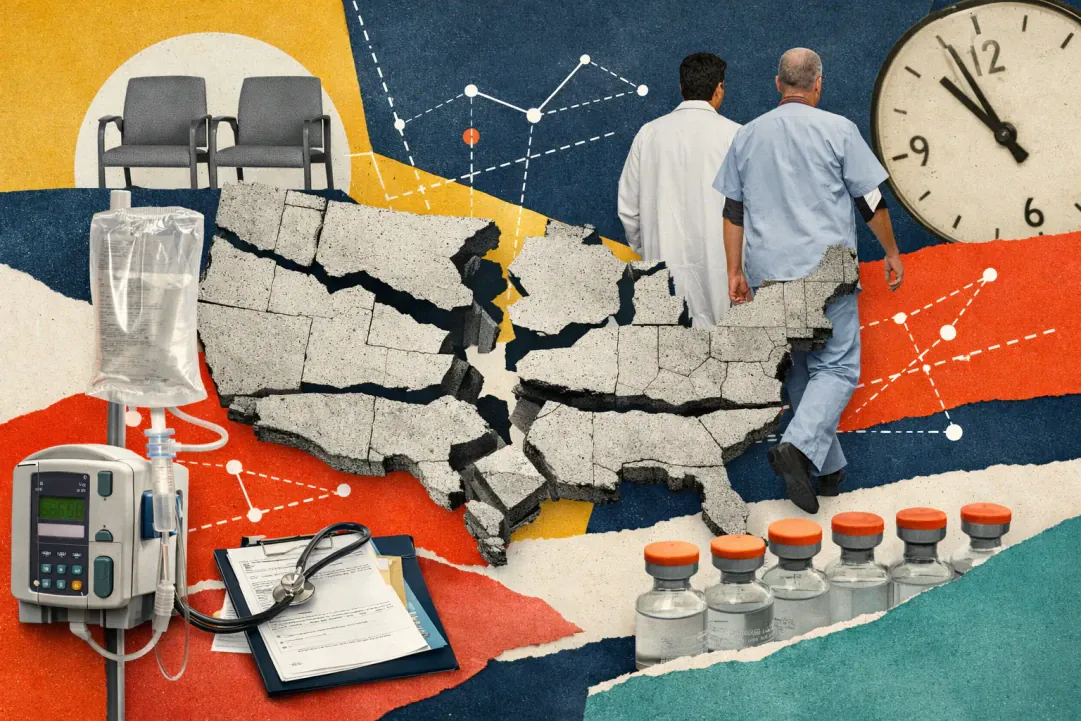
The Backbone of American Cancer Care Is Breaking
Most cancer patients start treatment in a community clinic, not an academic tower. That model is under siege—and the consequences are already measurable.
THE STORY IN 30 SECONDS
Seven out of 10 cancer patients now survive their diagnosis. A generation ago, it was 4 out of 10. The majority of that progress was delivered not in the towers of academic medicine but in local clinics embedded in communities across the country.
Community oncology practices treat more than 900,000 patients annually. Most Americans receiving cancer treatment—about 32 million—do so at an independent practice rather than a hospital system.
But over the last 15 years, roughly 1,750 of those independent practices have closed, been acquired, merged, or reported serious financial distress. The infrastructure that serves the majority of the country’s cancer patients is contracting at the same time patient volumes are growing.
We spoke with Dr. Neel Shah, a medical oncologist at Northwest Cancer Centers in Northwest Indiana and host of The DBT Podcast, about what community oncology actually looks like from the inside—and what is at stake if the model does not survive.
Every week of delay costs lives. Community practices move faster.
A 2020 BMJ meta-analysis of 1.2 million patients found that a 4-week delay in cancer treatment raised mortality risk 6–13% across 7 cancer types. The relationship was dose-dependent: for breast cancer surgery, a 12-week delay raised mortality by roughly 26%.
The national average time to treat at large academic centers sits at approximately 6 weeks, according to data published in The ASCO Post. A separate National Cancer Database study identified treatment at an academic center as an independent predictor of increased time to treatment, adding 2 to 9 extra days depending on cancer type.
Community oncology practices routinely beat that by a wide margin. At Northwest Cancer Centers, a 24-to-48-hour appointment window is standard.
Shah described a case from about a month before our conversation. A patient with advanced cancer had been told he needed to go to a university center. He waited. Months passed. His primary care physician eventually made a call: “You shouldn’t be waiting this long. You need to see someone right away.” Northwest Cancer Centers saw the patient the next day. Treatment started within a week. His liver was failing.
“He’s still with us. We’ve turned a potentially terminal disease into a chronic condition. And I think that’s where cancer is headed. I’m not sure we’re going to cure all cancer. But I do think we can turn cancer into a chronic disease versus a death sentence.”
As Prof. Clare Turnbull of the Institute of Cancer Research noted, the survival benefit of reducing systematic delays in cancer pathways may exceed the benefit afforded by most emerging therapies.
For community oncology, speed to treatment is the therapy.
“He’s still with us. We’ve turned a potentially terminal disease into a chronic condition. And I think that’s where cancer is headed. I’m not sure we’re going to cure all cancer. But I do think we can turn cancer into a chronic disease versus a death sentence.”
— Dr. Neel Shah, Senior Partner, Northwest Cancer Centers
Same molecule, same staff, half the bill.
Community oncology delivers evidence-based cancer care at 30–50% lower cost than hospital outpatient departments, with comparable outcomes. On this point, the data are unambiguous.
On average, patients at community practices spend an estimated $35,774 per month compared to $60,697 at hospital systems—a gap of nearly $25,000 every month for the same care. A 2020 analysis found hospital prices for top infused cancer drugs averaged 86% more per unit than physician office prices.
The mechanism is structural. When community practices are acquired by hospitals, the new owners bill facility fees for outpatient chemotherapy, adding cost that independent practices simply do not charge. The care stays the same. The bill changes.
“Since we’re not part of a hospital, the cost of care is the lowest burden. A blood test done at an independent office versus a hospital is just a different cost. We’re not only able to provide the best care, but we’re also able to provide the lowest cost care.”
The financial toxicity loop. Research in The American Journal of Public Health links community oncology utilization to reduced cancer-related financial toxicity. Shah sees those consequences firsthand: “Salaries are not going up. Healthcare premiums are at an all-time high. Anytime those premiums go up, a lot of people don’t go to the doctor and get their mammogram or their colonoscopy.”
Northwest Cancer Centers runs an in-house patient foundation covering gas, groceries, utilities, and childcare during treatment. These interventions don’t appear in trial endpoints. But they shape whether patients complete therapy.
“Since we’re not part of a hospital, the cost of care is the lowest burden. A blood test done at an independent office versus a hospital is just a different cost. We’re not only able to provide the best care, but we’re also able to provide the lowest cost care.”
The academic monopoly on cutting-edge care is over.
The assumption that novel therapies and clinical trial access remain the province of major academic centers is one of the most durable in oncology. The evidence no longer supports it.
Northwest Cancer Centers was among the first in its region to administer immunotherapy, ahead of many academic institutions in Chicago and Indianapolis. The practice now administers bispecific antibodies in-office. Shah projects it will offer more trials than some of the region’s flagship academic institutions within the next year.
But barriers persist. A McKesson survey of more than 100 community oncologists found that while 93% reported trial participation benefits patients, 85% cited difficulty accessing trials in community settings. The infrastructure gap is real—but it is narrowing from the community side, not the academic one.
The consolidation wave is swallowing what works.
Between 2015 and 2022, the number of medical oncology practices decreased by 18%, even as the number of medical oncologists grew by 14%. The largest 102 practices now employ more than 40% of all medical oncologists.
Private equity has accelerated the shift: TPG’s $2.1 billion acquisition of OneOncology in 2023, McKesson’s $2.5 billion deal for Florida Cancer Specialists in 2024, and Cardinal Health’s $1.1 billion purchase of ION in late 2024. Research consistently shows that consolidation increases healthcare costs by reducing competition, and that increased hospital market concentration is associated with worse patient satisfaction.
Here is what actually collapses if this model fails. The majority of American cancer patients lose the fastest pathway to treatment—at the exact moment the evidence shows every week of delay costs lives. They lose the lowest-cost option, as financial toxicity already suppresses screening and therapy completion. And they lose physician-led, cancer-focused care in favor of systems where oncology is one of 15 priorities.
“I’m just a big believer in doctors deciding the health of a patient. Not the insurance company and not the hospital.”
“I’m just a big believer in doctors deciding the health of a patient. Not the insurance company and not the hospital.”
— Dr. Neel Shah, Senior Partner, Northwest Cancer Centers
The data settled this years ago. The system hasn’t caught up.
Shah identifies 3 priorities. Universal coverage—because patients who delay care over coverage gaps present at later stages and require more intensive treatment. Fewer hospital-employed oncologists and more physician-led independent practices—because hospitals charge more for the same care without improving outcomes. And stabilizing premiums—because rising costs suppress the screening that catches cancer early.
These are not fringe positions. They are the logical conclusions of the evidence: speed saves lives, independence lowers costs, and access to care depends on the infrastructure that delivers it.
Shah’s pitch to the next generation is direct: “I would encourage all doctors looking for jobs or looking to switch to consider community oncology. Hospitals realizing it’d be better to have independent oncologists—I think it will help with cancer care in the future.”
Community oncology has reached a tipping point. The question is no longer whether the model delivers. The question is whether enough physicians, policymakers, and payers will act on the evidence before the infrastructure erodes past the point of recovery.
The 7 out of 10 patients who survive their diagnosis may not realize how much of that progress depends on a model the system is actively dismantling.
EXPERT PROFILE
Neel Shah, MD, FACP
Board Certified in Hematology, Medical Oncology & Internal Medicine. Senior Partner, Northwest Cancer Centers—Northwest Indiana’s largest independent, physician-owned cancer practice. Adjunct Professor, Indiana University School of Medicine. Host of The DBT Podcast. Author of Salt March: An Origin Story.
This feature was prepared using published clinical research, national cancer surveillance data, and an original interview conducted by Curie.
Add Your Voice
Curie is built by and for clinicians across specialties. If there’s something shaping how you practice—a policy shift, a reimbursement problem, a clinical workflow that’s broken, or an issue you think the field isn’t talking about enough—we want to hear it. Any specialty, any setting. If you have a perspective worth sharing, we’re listening.
Reach us at [email protected]
SOURCES
- American Association for Cancer Research. AACR Cancer Progress Report 2024.
- American Oncology Network; Community Oncology Alliance. Community oncology patient volume and practice data.
- Community Oncology Alliance. 2020 Practice Impact Report.
- Hanna TP, et al. “Mortality due to cancer treatment delay.” BMJ. 2020;371:m4087.
- Khorana AA, et al. “Time to initial cancer treatment and association with survival.” PLOS One. 2019.
- Abraham J, Bolwell BJ. “Time to Treatment Is a Priority.” The ASCO Post, 2019.
- Turnbull C. Expert reaction to Hanna et al. Science Media Centre, 2020.
- Community Oncology Alliance; Gordan LN, et al. Site of care cost analysis. JCO, 2018.
- The American Journal of Public Health. Community oncology and financial toxicity studies.
- McKesson. Survey of community oncologists on clinical trial access.
- VMG Health; AJMC. Strategic consolidation in oncology, 2024–2025.
- American Medical Association. Statements by Dr. Barbara McAneny on physician-led care.
- Community Oncology Alliance. 340B Drug Pricing Program analysis.