Turn on cookies to sign in
Signing in saves your progress to your Curie account. We can only do that with cookies on — turn them on to continue.
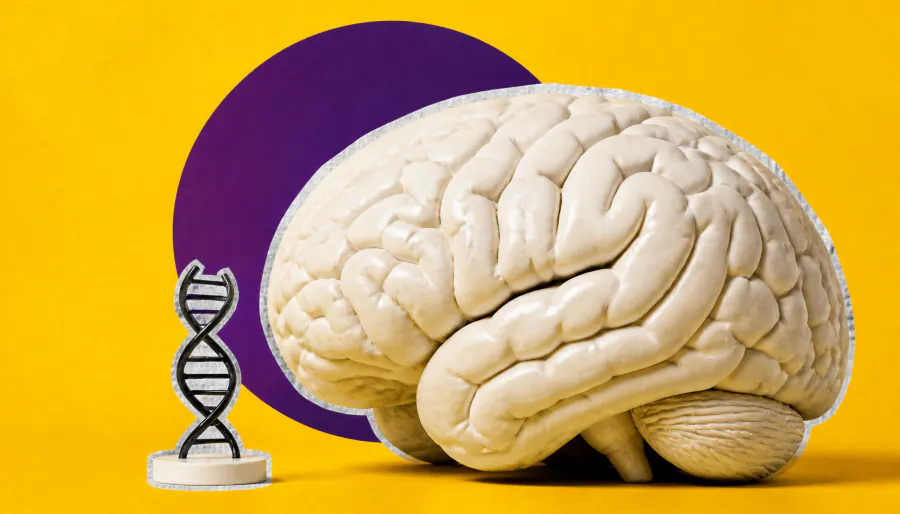
Scientists in Taiwan and Japan have identified a small regulatory DNA region that controls which types of brain-building cells are produced during development — and it differs between primates and other vertebrates. The discovery centers on the gene DACH1 and a specialized neural stem cell called basal radial glia (bRG), which are far more abundant in primate brains. This suggests evolution may have shaped our complex brains by tweaking genetic instructions, not just creating new genes.
Researchers at National Yang Ming Chiao Tung University, Academia Sinica, and Kyoto University have uncovered a new clue in one of science's biggest mysteries: why is the human brain so much larger and more complex than those of other mammals? The answer, it turns out, may lie not in entirely new genes, but in how existing ones are regulated.
The team zeroed in on DACH1 — a gene found in humans, monkeys, and mice alike — and discovered a small DNA regulatory region that acts like a genetic switch, controlling DACH1's activity during brain development. Crucially, one feature of this region is shared among primates but differs in non-primate vertebrates, suggesting it played a role in shaping the primate brain over evolutionary time. The study focused on basal radial glia (bRG), specialized neural stem cells that are abundant in primate brains but rare in mice, which help expand the cerebral cortex — the brain region responsible for perception, language, and memory.
By the Numbers:
Why it matters: This research reveals that evolution can reshape brain development by modifying genetic instructions rather than inventing new genes — opening new avenues for understanding brain complexity and improving laboratory models of brain development.