Turn on cookies to sign in
Signing in saves your progress to your Curie account. We can only do that with cookies on — turn them on to continue.
Targeting a systolic BP under 120 mm Hg in stroke and TIA patients significantly reduced major cardiovascular events compared to a standard target of under 140 mm Hg, the OPTIMAL-STROKE trial found. Over nearly 4 years, the intensive group saw a 10.9% MACE rate vs. 13.5% in the standard group. The catch? Aggressive treatment also came with a higher rate of renal complications.
The OPTIMAL-STROKE trial has delivered a landmark answer to a long-standing clinical question: how aggressively should blood pressure be managed after an ischemic stroke or TIA? The trial — the first adequately powered study to tackle this in a post-stroke population — found that targeting systolic BP below 120 mm Hg meaningfully reduced major adverse cardiovascular events (MACE) compared to a standard target below 140 mm Hg.
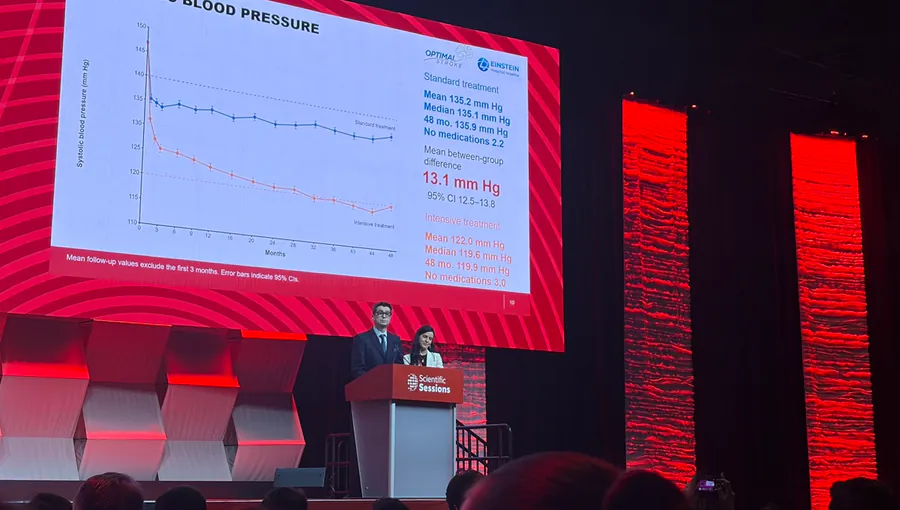
Presented at the 2026 American Heart Association Scientific Sessions and simultaneously published in the New England Journal of Medicine, the trial enrolled 4,368 patients across 30 centers in Brazil. The intensive group achieved a mean systolic BP of 122 mm Hg vs. 135.2 mm Hg in the standard group — a sustained 13 mm Hg difference over nearly 4 years. Experts noted that while the target was <120 mm Hg, the real-world takeaway may be aiming for the 120–125 mm Hg range.
By the Numbers
Why it matters: Prior intensive BP-lowering trials like SPRINT explicitly excluded post-stroke patients, leaving clinicians without clear guidance. OPTIMAL-STROKE fills that gap, suggesting aggressive BP management is beneficial — though regular renal function monitoring (at least annually) will be essential in this population.