Turn on cookies to sign in
Signing in saves your progress to your Curie account. We can only do that with cookies on — turn them on to continue.
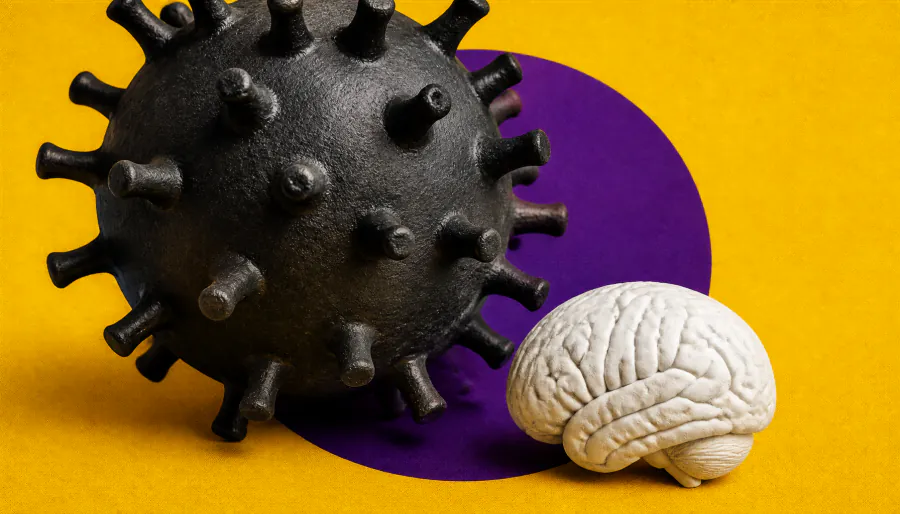
A virus that infected chimpanzees millions of years ago left behind genetic "fossils" that silenced a key brain development gene — one that remains active in humans. Researchers used brain organoids and CRISPR to confirm the viral remnant is responsible for switching off the LINC00662 gene in chimps. The findings shed new light on how gene regulation, not just gene presence, shaped the human brain.
Humans and chimpanzees share nearly identical DNA, so what makes our brains so different? A new study published in Science Advances points to an unexpected culprit: an ancient virus. Researchers at Lund University found that a viral remnant called PTERV1 — left behind in chimpanzee DNA after infecting the species millions of years ago — silences a gene called LINC00662 that plays a key role in early human brain development.
Using brain organoids (miniature 3D brain models grown from stem cells), the team showed that LINC00662 is highly active in human models but completely switched off in chimpanzee models. When they used CRISPR-Cas9 to remove the viral DNA from chimp cells, the gene turned back on — confirming the viral insertion as the culprit. Silencing the gene in human organoids, meanwhile, reduced activity in genes tied to nerve-cell development and neural connectivity.
Key Takeaways:
Why it matters: This research reframes our understanding of human brain evolution — it's not just about which genes we have, but which ones are turned on. Ancient viral infections may have inadvertently shaped the cognitive traits that define us as a species.