Curie Brief
Turn on cookies to sign in
Signing in saves your progress to your Curie account. We can only do that with cookies on — turn them on to continue.
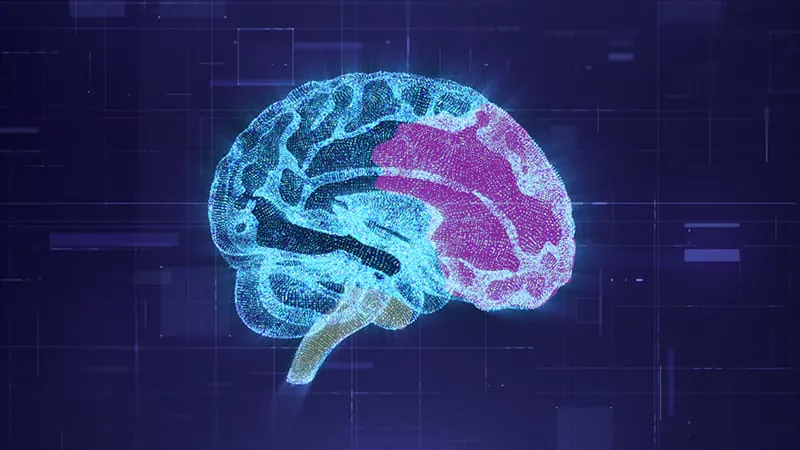
Stanford researchers have upended a long-held assumption in neuroscience: the brain isn't one unified organ — it's two. A new Nature Neuroscience study shows the forebrain/midbrain and hindbrain arise from entirely separate progenitor cells during early embryonic development. The discovery also unlocked a way to grow human hindbrain neurons in the lab, opening new doors for ALS and spinal muscular atrophy research.
For centuries, scientists assumed the brain developed from a single shared origin. A landmark Stanford Medicine study published in Nature Neuroscience flips that script — revealing that the brain is actually a "composite organ" built from two distinct progenitor cell populations that diverge as early as gastrulation, the stage when an embryo first lays out its body plan. One lineage forms the forebrain and midbrain (think language, reasoning, consciousness), while the other independently gives rise to the hindbrain (breathing, swallowing, heartbeat regulation).
This split explains a decades-long frustration in stem cell research: scientists couldn't grow hindbrain neurons in the lab because they were unknowingly trying to convert forebrain progenitors — cells that are fundamentally locked into a different fate. Using this new understanding, the Stanford team successfully guided human pluripotent stem cells into functional hindbrain motor neurons for the first time — cells that fired action potentials and expressed the right regional markers.
Key Takeaways:
Why it matters: ALS and spinal muscular atrophy (SMA — the leading genetic cause of death in infants) both destroy hindbrain motor neurons, but researchers have had no way to study them in living tissue. Growing these neurons in a dish could finally change that, accelerating the search for treatments.