Curie Brief
Turn on cookies to sign in
Signing in saves your progress to your Curie account. We can only do that with cookies on — turn them on to continue.
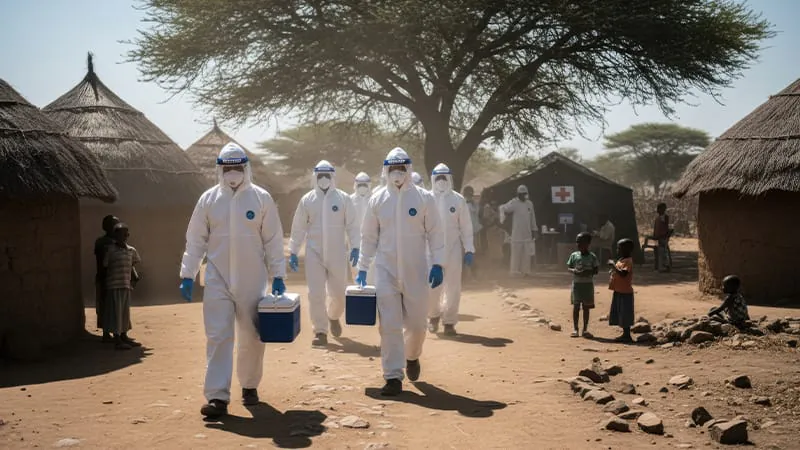
A Bundibugyo virus disease (BVD) outbreak in the DRC has become the country's worst Ebola-family crisis ever, with over 8,200 cases and nearly 4,000 deaths across seven provinces. No approved vaccine or treatment exists for BVD, and a ~50% fatality rate, resource shortages, and deep community mistrust are making containment extremely difficult. Researchers are now racing to evaluate potential treatments and cross-protective vaccines.
The Bundibugyo virus disease (BVD) outbreak in the Democratic Republic of the Congo (DRC) has become the most severe Ebola-family outbreak in the country's history. Confirmed across seven provinces as of late September 2026, the crisis has outpaced the early trajectory of the 2014–2016 West Africa Ebola epidemic sixfold in its first three months. Doctors Without Borders has warned that the outbreak is "not under control," citing severe resource shortages, overwhelmed health facilities, and a healthcare system already strained by cholera, measles, malaria, and malnutrition.
Containment is further hampered by fear, financial hardship, and deep community mistrust — factors that discourage patients from seeking care. Violence against healthcare workers and responders has also escalated, including the fatal beating of a Congolese politician who spoke publicly about the outbreak. Contact tracing remains critically limited, with the origin of nearly half of all cases unknown.
By the Numbers:
Why it matters: With no approved vaccine or specific treatment for BVD, the global health community is watching closely. Two clinical trials — the PARTNERS trial (testing monoclonal antibodies + remdesivir) and the EBO-PEP trial (testing obeldesivir for post-exposure prophylaxis) — launched in July 2026 and offer a potential path forward. Cross-border movement between DRC and Uganda also raises the risk of international spread.