Curie Brief
Turn on cookies to sign in
Signing in saves your progress to your Curie account. We can only do that with cookies on — turn them on to continue.
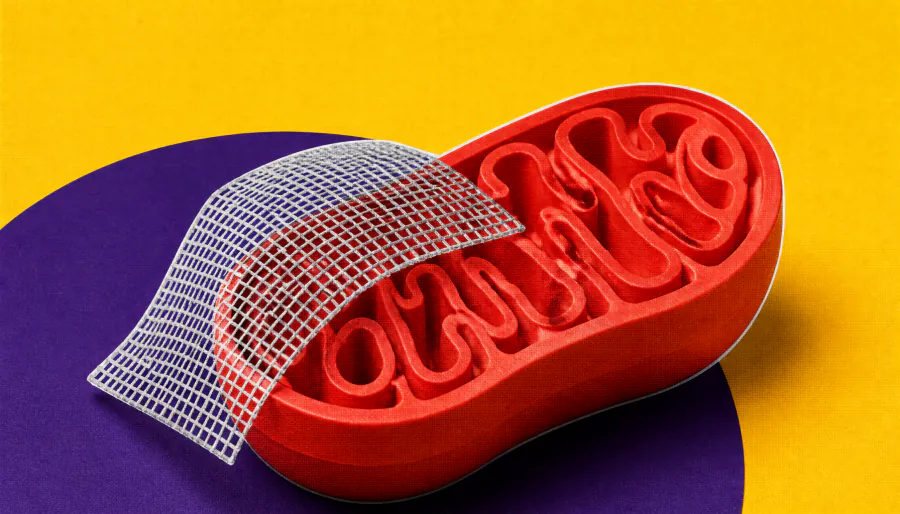
Researchers have found a way to wrap mitochondria — the energy-producing engines of our cells — in a high-tech material coating without disrupting their function. The breakthrough, published in JACS, uses Metal-Organic Frameworks (MOFs) and could open new doors for treating mitochondrial diseases, including potential applications in mitochondrial transplantation therapy.
Scientists in Italy have pulled off a delicate feat: coating mitochondria — the tiny structures that power our cells — with advanced materials called Metal-Organic Frameworks (MOFs), all without knocking out their ability to produce energy. The research, a collaboration between IRCCS Fondazione Istituto Neurologico Carlo Besta and Politecnico di Milano, was published in the Journal of the American Chemical Society.
MOFs are highly customizable materials that gained global recognition when the 2025 Nobel Prize in Chemistry was awarded for work in this field. The challenge was applying them to mitochondria, which are notoriously fragile. The team solved this by depositing tiny amounts of MOF directly onto the mitochondrial surface — and crucially, the coated mitochondria kept producing energy normally.
The real excitement lies in what comes next. Researchers believe the coating could be engineered for specific purposes, including facilitating mitochondrial transplantation — an experimental technique where healthy mitochondria are introduced into cells with faulty ones. That said, whether coated mitochondria actually outperform uncoated ones in transplantation still needs to be proven.
Key Takeaways:
Why it matters: Mitochondrial diseases are rare, often devastating, and largely untreatable. This coating technology could become a foundational tool for delivering healthier mitochondria to damaged cells — a potential game-changer for patients with few options.