Curie Brief
Turn on cookies to sign in
Signing in saves your progress to your Curie account. We can only do that with cookies on — turn them on to continue.
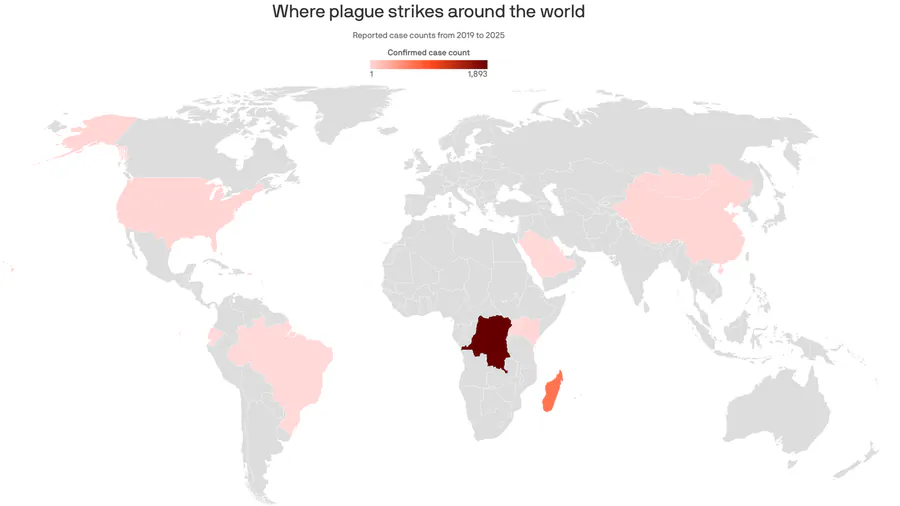
As Russia insists there's no plague outbreak following the death of a lab worker, global data reveals where the disease actually concentrates. Africa dominates the case counts, with the Democratic Republic of Congo leading worldwide. Meanwhile, the U.S., WHO, and international officials continue pressing Russia for transparency — and the CDC is monitoring travelers from Siberia as a precaution.
A suspected pneumonic plague case in Russia — involving the death of Darya Shipilova, a researcher at the Irkutsk Anti-Plague Research Institute — has put the disease back in the global spotlight. Russian authorities maintain that Shipilova died of "pneumonia of unknown etiology" unrelated to her lab work, and that 5,000 tests found no dangerous pathogens among nearly 200 contacts. But WHO, the U.S. State Department, and international health officials are still pressing Moscow for full transparency, including lab results and details on public health protocols.
While the Russia situation remains unresolved, global data paints a clearer picture of where plague actually thrives. The disease is endemic in parts of Africa and sporadically appears in the rural American West. In the U.S., a July 2025 pneumonic plague death in Arizona — linked to exposure to sick domestic cats — underscored the importance of rapid diagnosis and contact prophylaxis. All 46 potentially exposed individuals received preventive antibiotics and none fell ill.
By the Numbers:
Why it matters: Plague is treatable with antibiotics, but only if caught early — pneumonic plague can be fatal within hours of symptom onset. Russia's lack of transparency is hampering global risk assessment, while the Arizona case is a reminder that the disease hasn't disappeared even in developed nations.