Curie Brief
Turn on cookies to sign in
Signing in saves your progress to your Curie account. We can only do that with cookies on — turn them on to continue.
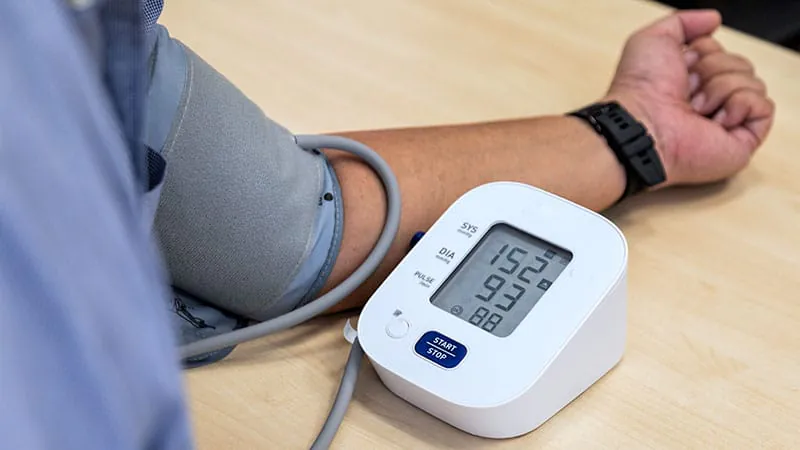
A noninvasive device that delivers gentle electrical stimulation near the ear canal was found to be safe and well-tolerated in patients with uncontrolled hypertension — but it didn't lower blood pressure significantly better than a sham device. One silver lining: patients with very high baseline systolic BP (≥160 mm Hg) showed a notably greater reduction with the real device. The findings come from a phase 2a trial published in Hypertension.
A small but promising technology called transcutaneous autonomic neuromodulation (tAN) — which delivers electrical stimulation via clips placed in front of the ear canal — passed its safety test in a new phase 2a trial, but fell short of proving it can meaningfully lower blood pressure in patients with uncontrolled hypertension.
In the double-blind trial of 63 adults already on antihypertensive medications, participants self-administered 30-minute daily stimulation sessions for two weeks, then once weekly for 10 weeks. At the three-month mark, both the tAN group and the sham group saw reductions in daytime systolic BP — but the difference between them wasn't statistically significant. Adherence was excellent (100% in both arms), and no serious side effects were linked to the device.
There was one intriguing signal: patients with a baseline systolic BP of 160 mm Hg or higher saw a 12.73 mm Hg greater reduction with tAN versus sham — a finding researchers flagged as exploratory but worth pursuing.
By the Numbers:
Why it matters: While tAN didn't outperform sham treatment in the broader group, its strong safety profile and the signal in higher-risk patients keep the door open for future, better-powered trials targeting those who might benefit most.