Curie Brief
Turn on cookies to sign in
Signing in saves your progress to your Curie account. We can only do that with cookies on — turn them on to continue.
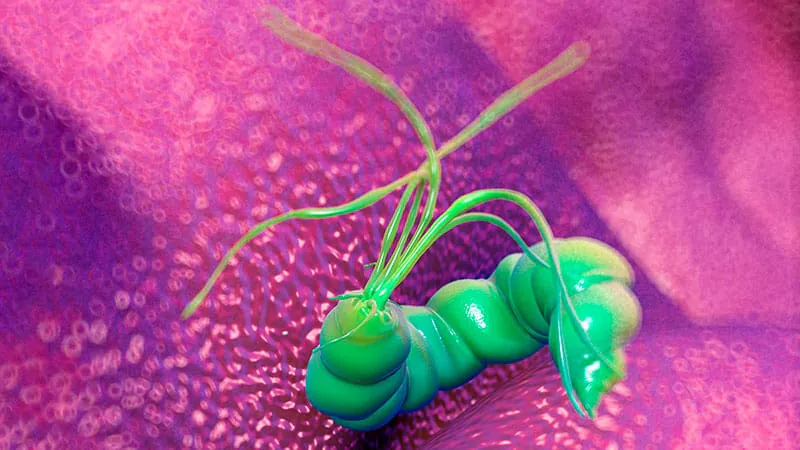
The go-to rapid test for H. pylori misses nearly 1 in 3 infections in patients with bleeding ulcers. A new study finds that tissue PCR is the most accurate single test, and combining it — or a breath test — with the standard rapid test and histology can catch 100% of infections. Better detection means better treatment and fewer misclassified ulcers.
The rapid urease test (RUT) is the workhorse of H. pylori diagnosis, but it has a significant blind spot: it misses about 30% of infections in patients with peptic ulcer bleeding. A new prospective study out of Thailand compared six diagnostic tests in 135 adults with endoscopically confirmed peptic ulcer bleeding, and the results make a strong case for rethinking the standard diagnostic approach.
Tissue PCR emerged as the top-performing single test, with 97.2% sensitivity and 92.9% specificity — significantly outperforming RUT. Even pairing RUT with histology only caught 83.3% of infections. But when PCR or a delayed urea breath test (UBT) was added to the RUT-plus-histology combo, sensitivity jumped to 100%.
By the Numbers:
Why it matters: Missing H. pylori in bleeding ulcer patients means missed treatment, higher reinfection risk, and ulcers incorrectly labeled as idiopathic. While PCR is the gold standard when available, the breath test remains a cost-effective alternative — giving clinicians a practical path to near-perfect detection.