Curie Brief
Turn on cookies to sign in
Signing in saves your progress to your Curie account. We can only do that with cookies on — turn them on to continue.
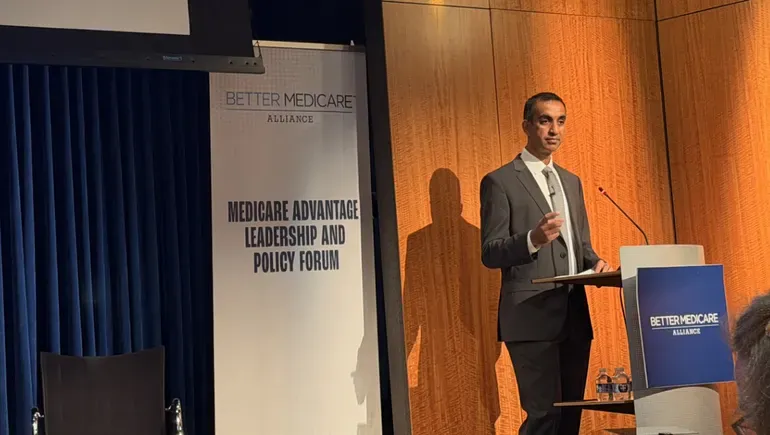
MedPAC's chair took his case straight to the insurance industry, defending the commission's finding that Medicare Advantage costs the government 14% more than traditional Medicare — about $76 billion extra in 2026. Insurers say the methodology is flawed, and Congress is now weighing in. The debate is shaping up to be one of the biggest Medicare reform battles in years.
MedPAC's chair walks into the lion's den
Dr. Amol Navathe, chair of the Medicare Payment Advisory Commission (MedPAC), made a bold move this week — defending his agency's research at an event hosted by the Better Medicare Alliance, a major Medicare Advantage (MA) lobbying group. At issue: MedPAC's widely cited estimate that the U.S. government will spend 14% more — roughly $76 billion — on MA enrollees in 2026 than it would if those same seniors were in traditional Medicare.
Navathe was clear that the estimate isn't a call for a 14% cut to MA, but rather a tool to drive meaningful policy conversations. He emphasized MedPAC's commitment to transparency and openness to methodological critique — even from the industry itself. Insurers, however, argue MedPAC's analysis doesn't account for key structural differences between MA and fee-for-service Medicare, and are pushing a competing CMS study that shows far lower overpayments. The lobbying push has reached Capitol Hill, where House Republicans recently advanced a bill that would require MedPAC to publish two separate spending analyses — one that includes the effect of "favorable selection" and one that doesn't.
By the Numbers
Why it matters: With Congress actively considering MA reform — including potential payment cuts — the battle over whose data gets trusted could directly shape the future of a program covering tens of millions of American seniors.