Curie Brief
Turn on cookies to sign in
Signing in saves your progress to your Curie account. We can only do that with cookies on — turn them on to continue.
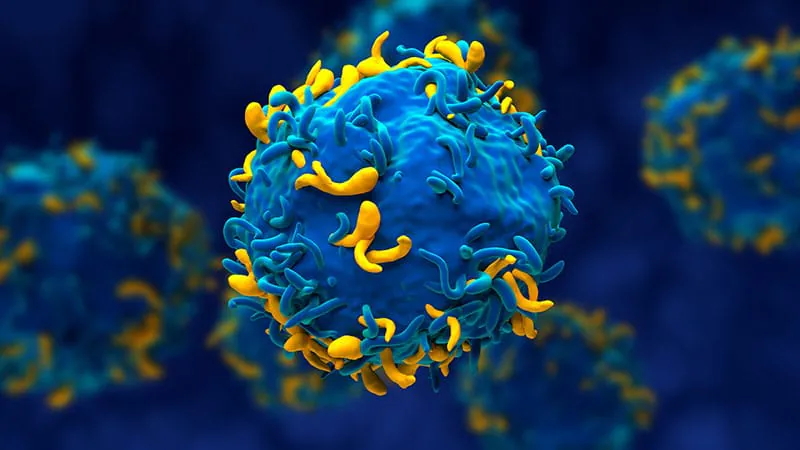
CAR T-cell therapy is rewriting the rulebook for blood cancers. In aggressive lymphoma, it's delivering a 50% survival rate vs. 30% with standard care, while in multiple myeloma, nearly all heavily pretreated patients responded — with some showing a survival plateau that hints at an outright cure. Now, 10-year data confirm that roughly a third of lymphoma patients remain cancer-free a decade after a single infusion.
CAR T-cell therapy — which engineers a patient's own T cells to hunt down tumor cells — is producing results that are turning heads across hematology. For patients with early-relapsed or refractory diffuse large B-cell lymphoma (DLBCL), axicabtagene ciloleucel (axi-cel) delivers a 50% survival rate compared to just 30% with standard care, earning it second-line coverage status. In multiple myeloma, ciltacabtagene autoleucel (cilta-cel) achieved near-universal responses in heavily pretreated patients — with a median progression-free survival of ~3 years and an emerging plateau in both PFS and overall survival, suggesting some patients may actually be cured.
Reinforcing the long-term promise, a landmark 10-year study of tisagenlecleucel (Kymriah) in relapsed/refractory B-cell lymphomas found that ~32% of large B-cell lymphoma patients and 47% of follicular lymphoma patients remained lymphoma-free — with no relapses occurring after 5.4 years. Researchers at Penn Medicine described the findings as consistent with a cure in some patients.
By the Numbers
100 days: how long delayed neutropenia can persist post-infusion
Why it matters: These results mark a genuine paradigm shift — from managing blood cancers long-term to potentially curing them. As CAR T expands into solid tumors like glioblastoma, and next-gen "off-the-shelf" and in vivo approaches emerge, the therapy's reach is only set to grow.