Curie Brief
Turn on cookies to sign in
Signing in saves your progress to your Curie account. We can only do that with cookies on — turn them on to continue.
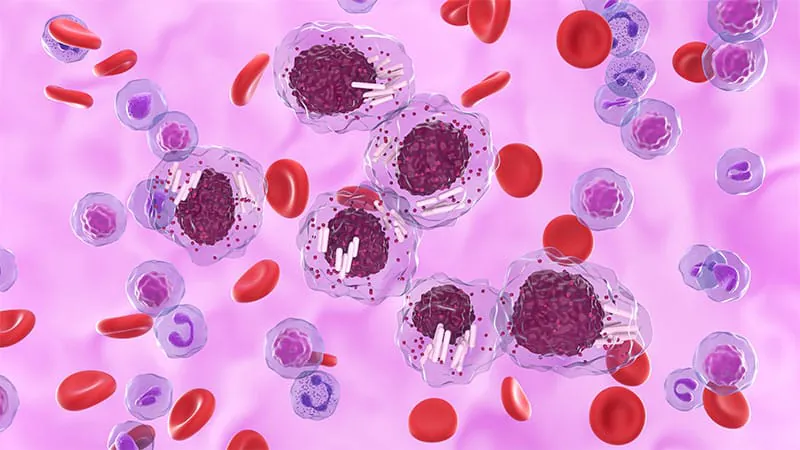
A triplet regimen of pirtobrutinib, venetoclax, and obinutuzumab is showing remarkable results in treatment-naive chronic lymphocytic leukemia (CLL) patients, with 2-year progression-free and overall survival rates of 99%. The PIVOT-CLL phase 2 trial marks the first use of a noncovalent BTK inhibitor in first-line CLL combination therapy. But the excitement is tempered by significant toxicity concerns, particularly high rates of severe neutropenia.
A new triplet drug regimen is turning heads in the CLL treatment landscape. The PIVOT-CLL phase 2 trial tested pirtobrutinib — a next-generation, noncovalent BTK inhibitor — combined with venetoclax and obinutuzumab in 80 treatment-naive CLL patients. The results showed near-perfect 2-year progression-free survival (PFS) and overall survival (OS) rates of 99%, along with deep undetectable measurable residual disease (MRD) responses after 13 cycles of therapy. It's the first time a noncovalent BTKi has been used in a first-line CLL combination regimen.
The excitement, however, is balanced by real safety concerns. Grade 3–4 neutropenia hit 69% of patients, and more than half required growth factor support. Dose reductions were common, and one patient died from infection after completing therapy — raising questions about whether this regimen is appropriate for older or less fit patients seen in community settings. Experts note the toxicity profile is consistent with other CLL triplet regimens, but warrants close monitoring.
By the Numbers:
Why it matters: Pirtobrutinib's ability to overcome C481 resistance mutations — a common failure point for older BTK inhibitors — makes it a compelling frontline candidate. Supporting this, phase 3 data from the BRUIN CLL-322 trial showed the pirtobrutinib triplet also significantly improved PFS in relapsed/refractory CLL vs. standard doublet therapy. Together, these trials suggest a potential paradigm shift in CLL treatment, though the toxicity burden means patient selection will be critical.