Loading Curie Briefs...
Getting the latest healthcare news for you
Getting the latest healthcare news for you

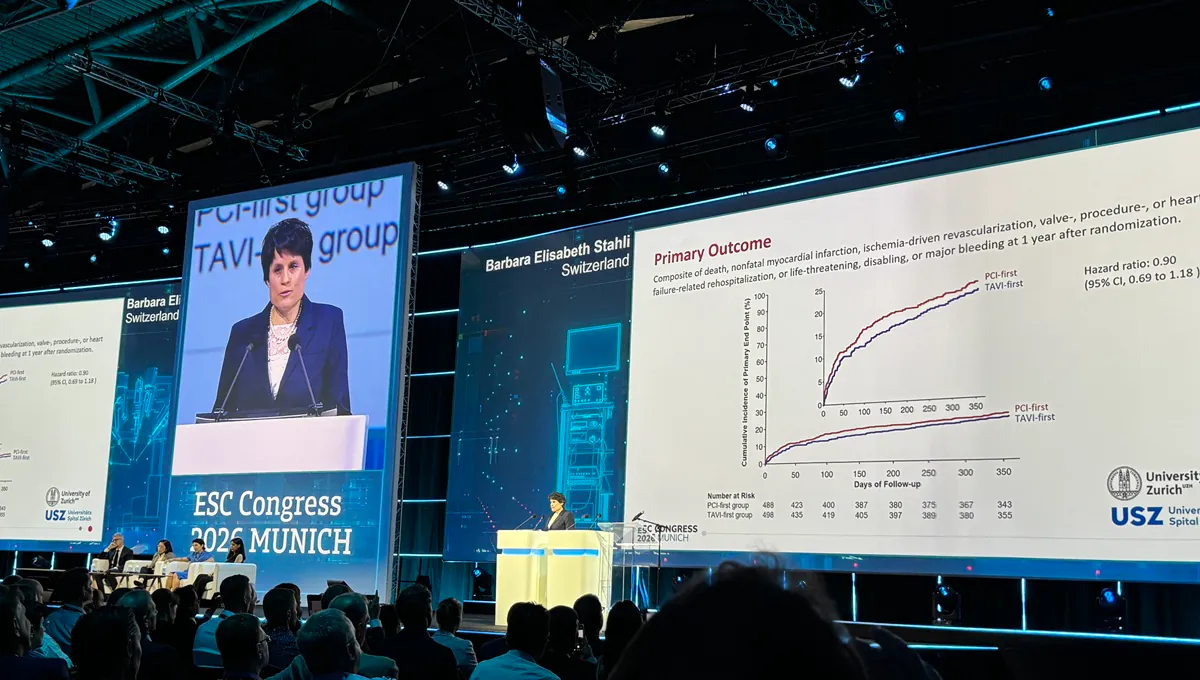
For patients needing both a transcatheter aortic valve implantation (TAVI) and a coronary stenting procedure (PCI), the order may not matter as much as once thought. The TAVI PCI trial, published in the NEJM, found that doing TAVI before PCI was just as safe as the traditional PCI-first approach at one year. Experts say the decision should now be tailored to each patient's individual risk profile.
For decades, the standard playbook for patients needing both a transcatheter aortic valve implantation (TAVI) and a coronary artery stenting procedure (PCI) has been: fix the coronaries first. But the landmark TAVI PCI trial, presented at the European Society of Cardiology Congress 2026 and simultaneously published in the New England Journal of Medicine, is offering a new perspective.
The trial enrolled 986 patients across 48 European centers and found that doing TAVI first was noninferior to the traditional PCI-first approach at one year. Notably, patients in the TAVI-first group ended up needing fewer PCI procedures overall — not because coronary access was blocked, but because fixing the valve sometimes changed the clinical picture entirely. A supporting meta-analysis of four prior randomized trials (ACTIVATION, FAITAVI, NOTION-3, TCW) found only a modest 30% relative reduction in MACE with PCI vs. optimal medical therapy before TAVI, driven largely by fewer unplanned revascularizations — with no difference in mortality.
Why it matters: This trial gives clinicians real flexibility. Rather than a one-size-fits-all approach, operators can now weigh individual factors — bleeding risk, lesion complexity, and antiplatelet therapy timing — when deciding the order of procedures. The ongoing COMPLETE TAVR trial may further clarify whether routine PCI is necessary at all versus medical management alone.