Loading Curie Briefs...
Getting the latest healthcare news for you
Getting the latest healthcare news for you

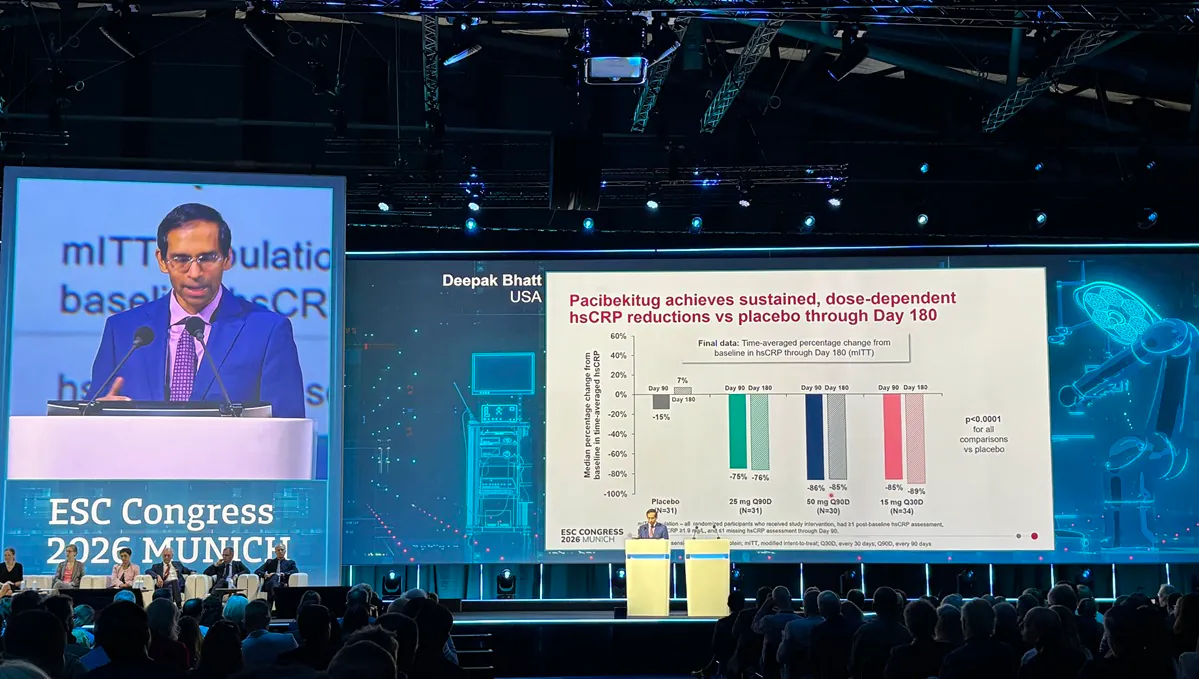
A phase II trial shows the IL-6 antibody pacibekitug dramatically reduces inflammatory markers in chronic kidney disease patients, but whether that translates to fewer heart attacks or strokes remains unknown. This comes on the heels of the ZEUS trial, where a similar IL-6 blocker (ziltivekimab) cut inflammation but failed to reduce major cardiovascular events. Researchers say the inflammatory hypothesis isn't dead — it just needs the right drug matched to the right patient.
The phase II TRANQUILITY trial, presented at ESC Congress 2026, found that pacibekitug — an IL-6 antibody now under Novartis following its acquisition of Tourmaline Bio — produced dramatic, sustained reductions in hs-CRP and other inflammatory markers over 6 months in patients with chronic kidney disease (CKD) and elevated baseline inflammation. The drug was also well-tolerated, with no clear dose-related safety signals. But the big unanswered question remains: do these biomarker improvements actually prevent heart attacks and strokes?
The trial lands in a complicated moment. Just weeks earlier, the phase III ZEUS trial showed that ziltivekimab — another IL-6 inhibitor — reduced inflammation but had virtually zero impact on major adverse cardiovascular events (MACE) in a similar ASCVD + CKD population. Experts caution that CKD patients are notoriously difficult to treat, and that IL-6 blockade may simply be too far downstream in the inflammatory cascade to make a meaningful clinical difference.
By the Numbers
Why it matters: The inflammatory hypothesis for cardiovascular disease remains alive, but it's being stress-tested. Researchers argue that broader, upstream anti-inflammatory strategies — rather than single-target IL-6 blockade — may be needed to move the needle on hard cardiac outcomes.