Loading Curie Briefs...
Getting the latest healthcare news for you
Getting the latest healthcare news for you

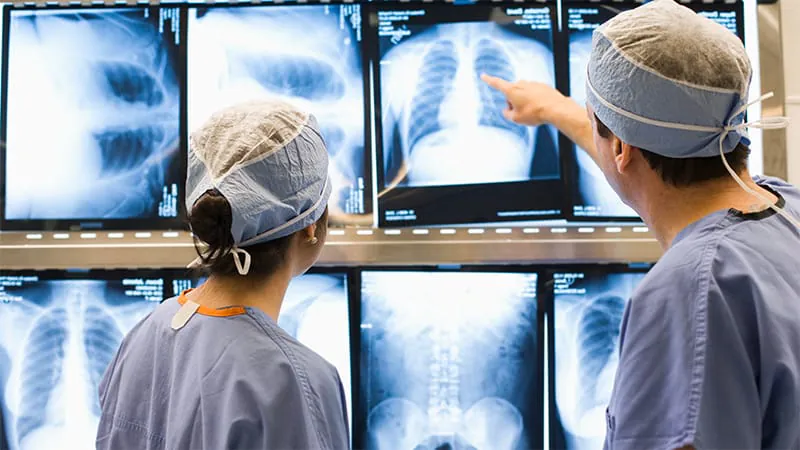
AI tools for chest radiographs cut reading times and boosted radiologist confidence, but a new real-world study found they actually hurt diagnostic accuracy. In 71% of cases where AI prompted a change, readers switched from a correct to an incorrect diagnosis. The harmful-to-beneficial ratio was a striking 2.45:1.
Speed isn't everything. A prospective crossover study out of Germany tested four commercial AI tools on chest radiograph interpretation — and the results are a cautionary tale for radiology departments considering AI adoption. While AI did help radiologists read scans faster and feel more confident, it failed to improve diagnostic accuracy across all five evaluated findings, and in many cases made things worse.
The most concerning finding: when AI prompted readers to change their initial call, 71% of those changes flipped a correct diagnosis to an incorrect one. Only 29% of AI-prompted revisions actually corrected an error — a harmful-to-beneficial ratio of 2.45:1. Accuracy for pulmonary nodules dropped from 98% without AI to as low as 91% with certain algorithms.
Key Takeaways:
Why it matters: As hospitals race to integrate AI into radiology workflows, this study is a reminder that faster and more confident doesn't always mean better. Overconfidence driven by AI could lead to missed diagnoses or unnecessary follow-ups — with real consequences for patients.