Loading Curie Briefs...
Getting the latest healthcare news for you
Getting the latest healthcare news for you

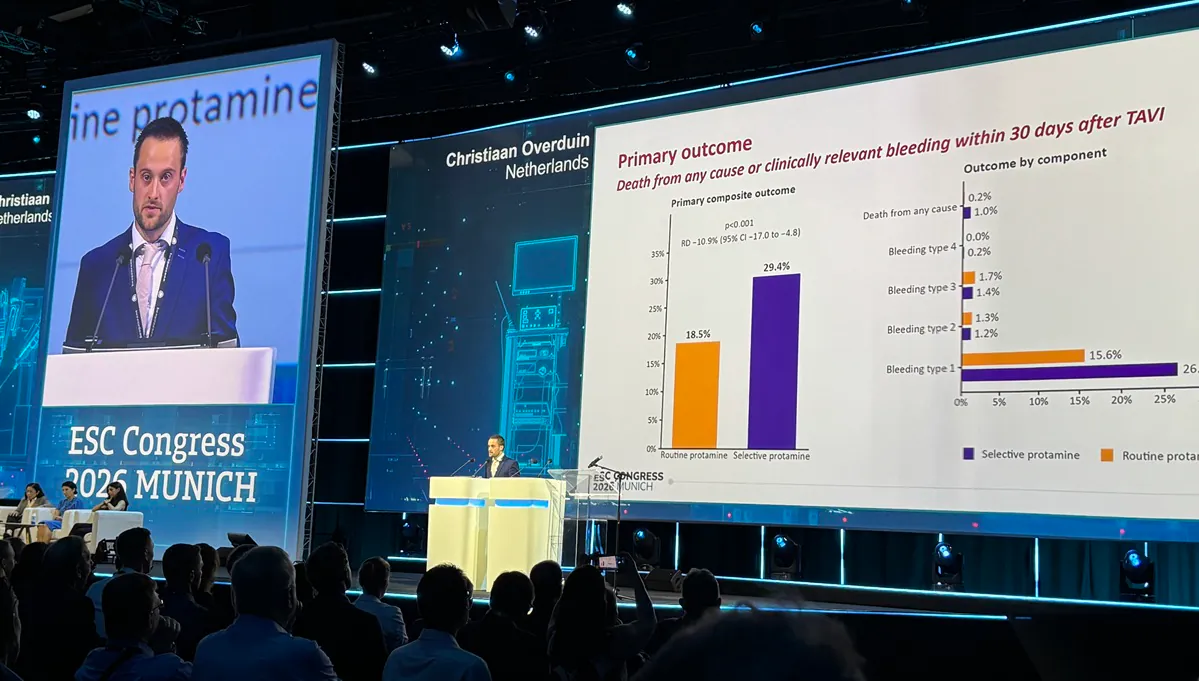
Giving protamine to all TAVI patients beats selective use for reducing bleeding, a new trial finds. The POPular ACE TAVI trial showed routine protamine significantly lowered the composite of death and clinically relevant bleeding, driven by fewer minor bleeds. But since it didn't reduce major bleeding or mortality, some experts say it's not yet practice-changing.
The POPular ACE TAVI trial, presented at the ESC Congress 2026 in Munich, found that routinely giving protamine — a heparin reversal agent — to all patients after transcatheter aortic valve implantation (TAVI) is superior to selective use. The primary composite outcome of all-cause death or clinically relevant bleeding within 30 days was meaningfully lower in the routine group, driven largely by a reduction in minor (type 1) bleeding.
Crucially, the routine strategy did not meaningfully increase anaphylaxis risk — a key concern that has historically made some operators hesitant. Still, expert opinions on whether this should change practice are divided. While the trial's lead investigator calls it a "definitive answer," outside commentators note the benefit was confined to minor bleeding, with no impact on major bleeding, vascular complications, or mortality.
By the Numbers:
Why it matters: For the thousands of patients undergoing TAVI annually, even minor post-procedural bleeding can complicate recovery. This trial offers the clearest evidence yet that routine protamine is safe and reduces bleeding burden — though clinicians may still weigh individual patient factors, including anticoagulation status and LV function, before adopting a universal approach.