Loading Curie Briefs...
Getting the latest healthcare news for you
Getting the latest healthcare news for you

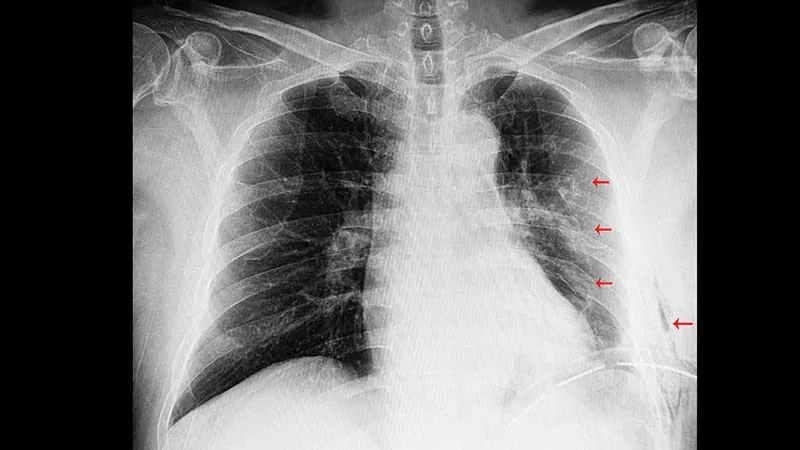
Smaller chest tubes, fewer complications. A large study of ~16,000 adults found that small-bore (SB) chest tubes were associated with significantly less subcutaneous emphysema compared to large-bore (LB) tubes in nontraumatic pneumothorax patients. SB tubes also showed lower odds of hemothorax, surgical escalation, and mortality — reinforcing the ongoing clinical shift toward percutaneous SB placement.
When it comes to chest tubes for nontraumatic pneumothorax, size really does matter — and smaller is better. A new study drawing on data from over 16,000 patients across 112 healthcare organizations found that small-bore (SB) chest tubes (≤14 Fr) were associated with meaningfully less subcutaneous emphysema (SE) compared to large-bore (LB) tubes. SE can lead to prolonged drainage, patient discomfort, extra imaging, and longer hospital stays — making it a clinically important endpoint that had previously been understudied.
After propensity score matching, 8,427 patients per group were analyzed. SB tubes came out ahead on nearly every measure, with lower odds of hemothorax/hemorrhage, need for video-assisted thoracoscopic surgery (VATS), tube malpositioning, and all-cause mortality. Experts note the percutaneous insertion technique used with SB tubes — rather than the open surgical approach typical of LB tubes — likely plays a major role in driving these better outcomes.
By the Numbers:
Why it matters: This study reinforces the growing clinical consensus that SB chest tubes should be the go-to for most nontraumatic pneumothoraces. While the findings are practice-affirming rather than practice-changing, they provide high-powered evidence supporting a limited role for LB tubes — and highlight the need for future research comparing percutaneous LB vs. SB tube placement directly.