Loading Curie Briefs...
Getting the latest healthcare news for you
Getting the latest healthcare news for you

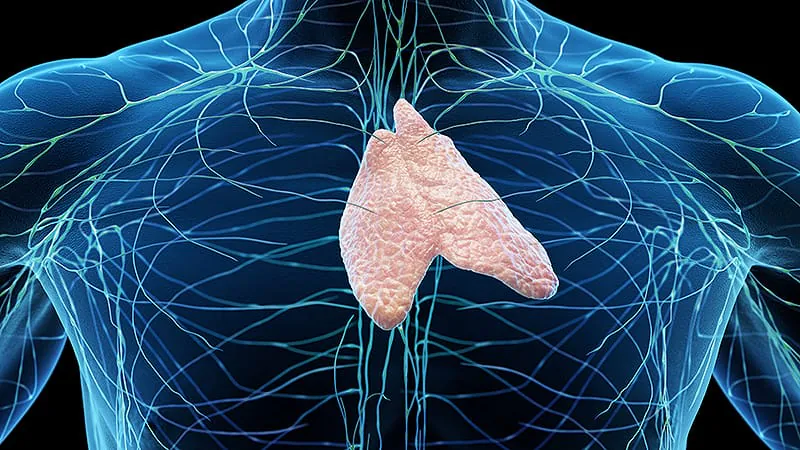
Radiating the thymus during lung cancer treatment could be making things worse. A study of over 1,100 NSCLC patients found that incidental thymic radiation was linked to higher rates of distant metastasis and death — especially in patients with preserved thymic function before treatment. Researchers say thymic sparing is technically feasible, but prospective validation is needed before changing standard practice.
The thymus has long been considered a bystander in adult cancer care, but a new multi-cohort study is challenging that assumption. Researchers analyzed data from 1,107 patients with locally advanced non-small cell lung cancer (NSCLC) across three cohorts and found that incidental radiation to the thymus during chemoradiotherapy (CRT) was independently associated with a significantly higher risk of distant metastasis — and, in some analyses, death.
The effect was most pronounced in patients who had preserved thymic function before treatment, suggesting that radiation may be impairing immune competence at a critical time. Using a deep learning model to assess thymic health from routine CT scans, the team found that the damage was dose-dependent and biologically plausible. A small replanning study also showed that thymic-sparing is technically achievable without compromising tumor coverage.
By the Numbers:
Why it matters: As immunotherapy becomes a cornerstone of cancer care, protecting immune organs like the thymus during radiation may be key to maximizing treatment outcomes. Researchers and outside experts agree: thymic sparing could be implemented quickly with existing technology — once prospective trials confirm the benefit.