Loading Curie Briefs...
Getting the latest healthcare news for you
Getting the latest healthcare news for you

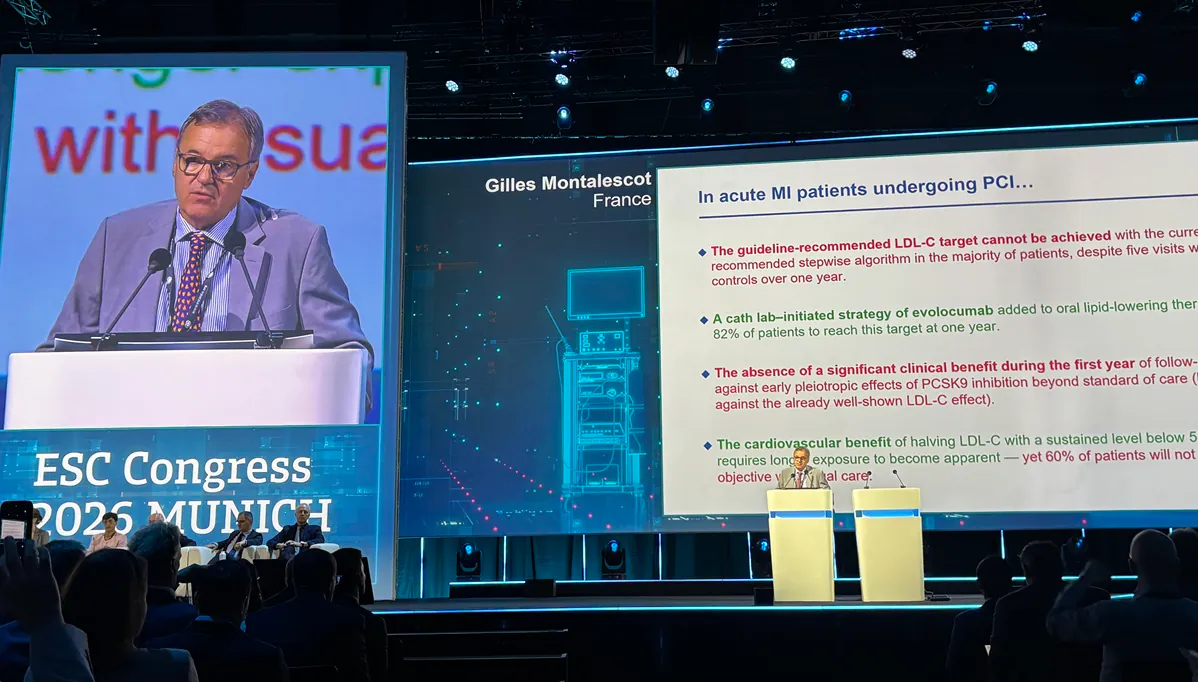
Starting evolocumab before PCI in acute MI patients drove LDL cholesterol to record-low levels, but didn't cut death or rehospitalization rates within a year. The AMUNDSEN trial found 82% of patients on early evolocumab hit guideline LDL targets vs. just 40% on standard care. Experts say the real clinical payoff likely requires years of follow-up, not months.
The AMUNDSEN trial set out to answer a pressing question in cardiology: does starting a PCSK9 inhibitor in the cath lab — before a patient even undergoes PCI for an acute MI — give them a meaningful edge? The answer is a resounding yes for LDL control, but a "not yet" for hard clinical outcomes.
Among 2,161 patients with STEMI or high-risk NSTEMI, those who received evolocumab (Repatha) immediately before PCI achieved guideline-recommended LDL targets (below 55 mg/dL with ≥50% reduction) at a rate of 82%, compared to just 40% in the standard-care group. At 6 weeks, the median LDL in the early-treatment group hit just 16 mg/dL — a level experts called "groundbreaking." However, the primary clinical endpoint — all-cause death or unplanned CV hospitalization at 1 year — showed no significant difference between groups (14.6% vs. 15.4%).
Experts point to the 1-year follow-up as the likely culprit for the neutral clinical result, noting that LDL-lowering benefits on cardiovascular events typically take years to materialize. The ongoing EVOLVE-MI trial, with a planned median follow-up of 3.5–4 years, may provide the definitive answer.
By the Numbers
Why it matters: For high-risk MI patients, getting LDL as low as possible, as fast as possible, is increasingly seen as a clinical imperative. AMUNDSEN reinforces that early, aggressive lipid-lowering is achievable — and while the survival benefit may take years to show up in trials, the biological rationale for acting fast remains strong.