Loading Curie Briefs...
Getting the latest healthcare news for you
Getting the latest healthcare news for you

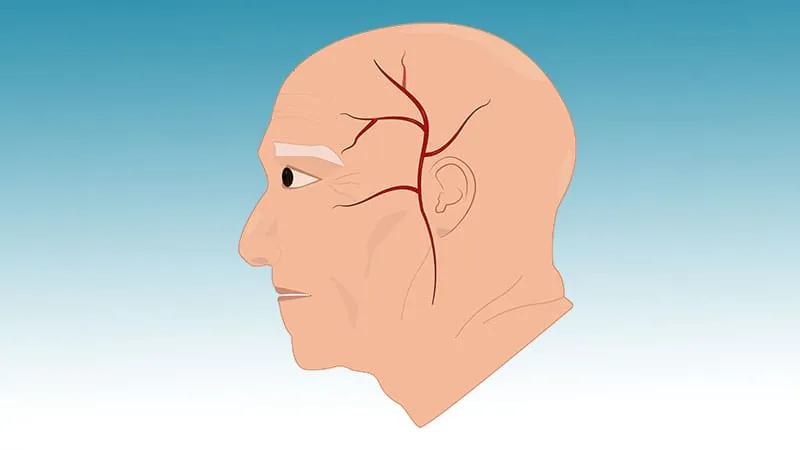
Despite guideline-based tapering, many giant cell arteritis (GCA) patients remain on glucocorticoids (GCs) for years — and even low doses carry serious risks. A Danish cohort study found fewer than half of patients had stopped GCs by the 2-year mark, while a large French study confirmed that every additional gram of cumulative GC exposure raises the odds of death, infection, and cardiovascular events.
Two new studies paint a sobering picture of glucocorticoid (GC) use in giant cell arteritis (GCA): patients are staying on steroids far longer than guidelines intend, and the cumulative toll on their health is measurable even at low doses.
A Danish retrospective cohort study of 172 GCA patients diagnosed between 2018 and 2020 found that despite rapid diagnosis and strict tapering protocols, only 43% had discontinued GCs by 2 years and 58% by 3 years. Patients with a prior diagnosis of polymyalgia rheumatica (PMR) or GCA were significantly less likely to stop GCs, with a 46% lower probability of discontinuation compared to new-onset patients.
A larger French population-based study of over 18,000 GCA patients reinforced the urgency. Even as high-dose trajectories declined modestly between 2010 and 2022, average 2-year cumulative GC doses remained high. Tocilizumab use has surged — over 25% of 2022-diagnosed patients received it — but hasn't yet eliminated the steroid burden.
By the numbers:
Why it matters: GCA is a chronic disease that often demands prolonged steroid use — but these studies confirm there's no truly "safe" dose. With even low-level GC exposure tied to mortality and serious complications, the push to find effective steroid-sparing strategies has never been more critical.