Loading Curie Briefs...
Getting the latest healthcare news for you
Getting the latest healthcare news for you

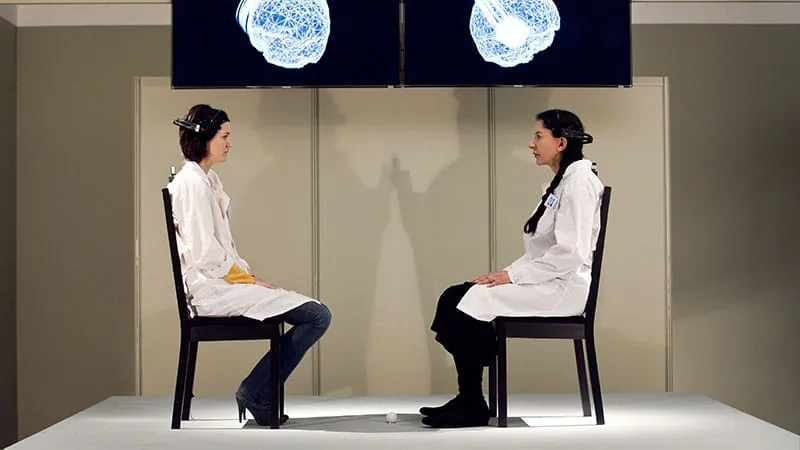
Getting on the same wavelength is more than a figure of speech — it's measurable brain activity. Researchers using EEG technology have found that people who feel emotionally close show stronger neural synchrony, with brainwaves literally rising and falling together. From music studios to soccer stadiums, scientists are now exploring how to harness this phenomenon to improve social connection and even therapy.
Getting on the same wavelength is more than a figure of speech — it's measurable brain activity. Inspired by artist Marina Abramović's silent gaze experiment at MoMA, neuroscientist Suzanne Dikker, PhD, began tracking brain-to-brain synchrony outside the lab, bringing EEG technology to museums, classrooms, music festivals, and recording studios. Her research, along with work by other scientists, shows that when two people feel genuinely connected, their neural oscillations actually align in measurable ways.
The findings suggest that shared experiences — from pregame rituals and live music to simple eye contact and small talk — can encourage biological synchrony. Dikker's Mutual Wave Machine study of 726 participants found that people who knew each other longer or felt closer showed stronger neural coupling, predicted by factors like empathy, joint action, and engagement.
Key Takeaways:
Why it matters: Understanding neural synchrony could reshape how clinicians approach therapist-client dynamics, social cohesion interventions, and even treatments for social disconnection — a growing concern in an increasingly technology-mediated world.