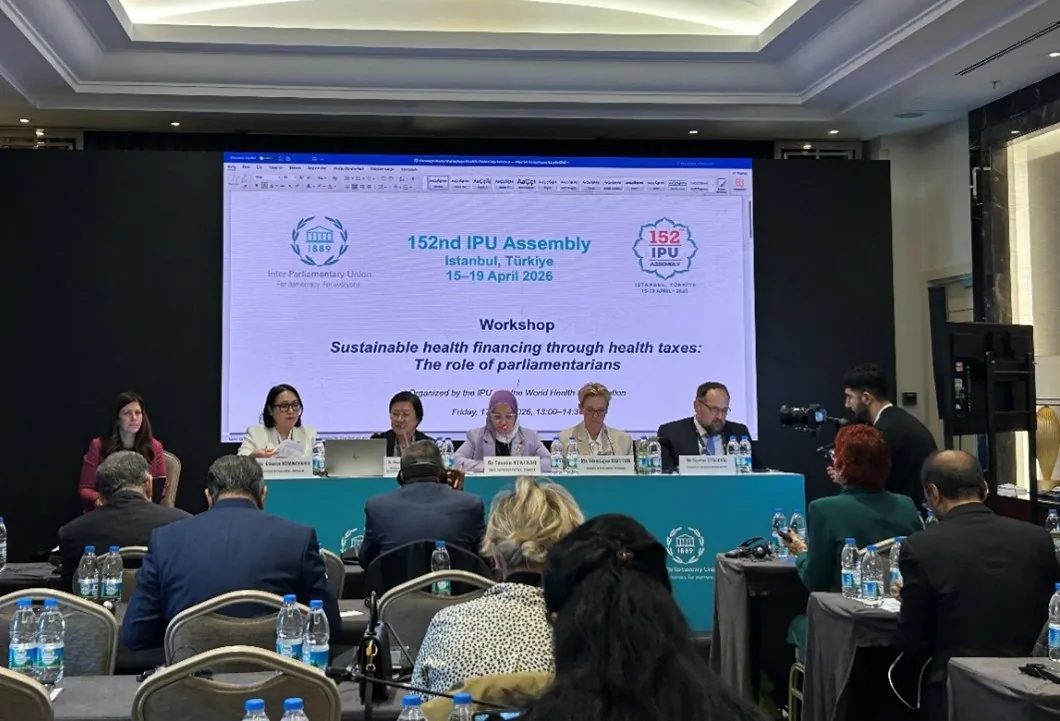
WHO took center stage at the 152nd Inter-Parliamentary Union Assembly in Istanbul, pushing forward the WHO Pandemic Agreement and making the case for health taxes as a smart financing tool. Over 720 parliamentarians from 126 countries gathered to align national legislation with global health commitments. The message was clear: parliaments are the bridge between international agreements and real-world action.
WHO showed up in force at the 152nd Inter-Parliamentary Union (IPU) Assembly in Istanbul (April 15–19, 2026), using the platform to advance two big priorities: the WHO Pandemic Agreement and sustainable health financing through health taxes. With over 720 parliamentarians from 126 countries in the room, WHO briefed the IPU Committee on Health about the Pandemic Agreement — adopted in May 2025 — and ongoing negotiations around the Pathogen Access and Benefit-Sharing (PABS) annex, which aims to ensure timely data sharing and equitable access to health products during future outbreaks.
On the financing front, WHO and IPU co-hosted a workshop highlighting health taxes on tobacco, alcohol, and sugary drinks as a dual-purpose tool: reducing consumption of major NCD risk factors while generating revenue for health systems. Parliamentarians were urged to champion this legislation at home and protect health budgets from political pressures.
Key Takeaways:
Why it matters: Global health agreements only work if countries follow through — and that requires legislative action. By engaging parliamentarians directly, WHO is trying to close the gap between international commitments and on-the-ground implementation.