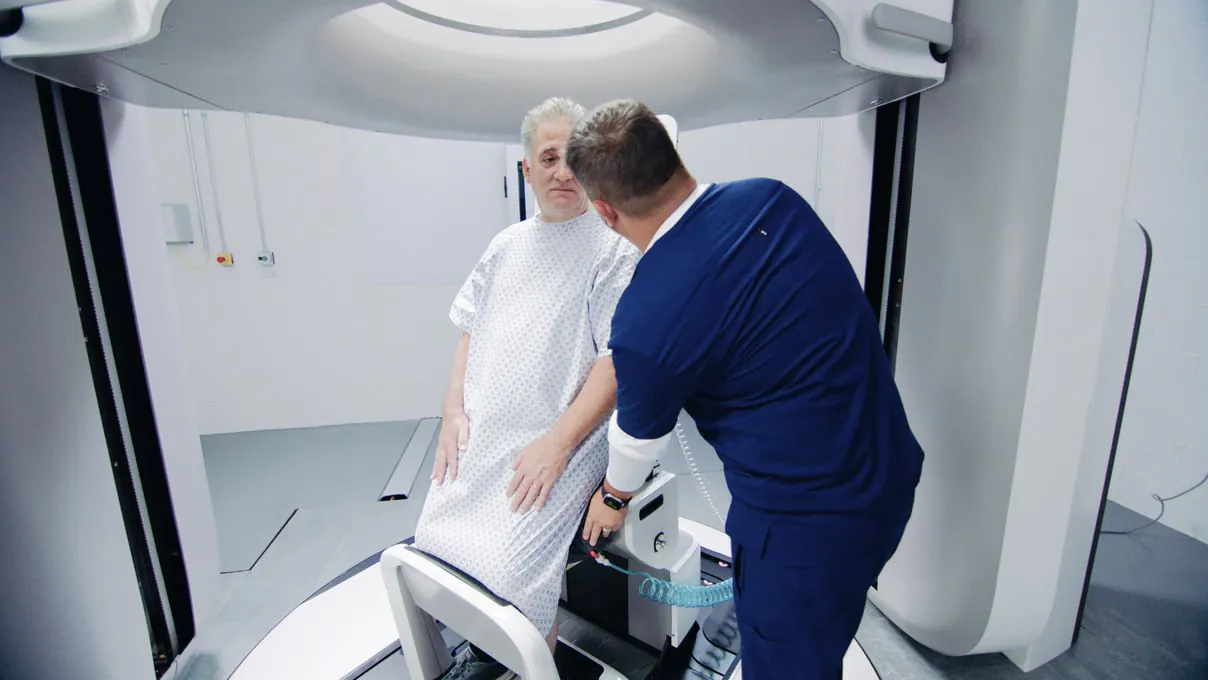
Radiation therapy just got a major upgrade — and a new funding boost. Leo Cancer Care closed a $65M Series D round to scale its upright radiotherapy platform, which lets patients sit up during treatment instead of lying flat. The technology slashes the cost and footprint of proton therapy by up to 50%, and Stanford already delivered the world's first compact upright proton treatment in June. An IPO is on the horizon.
Radiation therapy just got a major upgrade — and a serious cash infusion. Leo Cancer Care, founded in 2018, closed a $65M Series D round led by Yu Galaxy to scale its groundbreaking upright radiotherapy platform. The company has now raised $155M in total and is eyeing a multi-billion-dollar IPO by year's end, alongside a new (yet-to-be-named) strategic partnership with an international healthcare giant.
The big idea? Instead of rotating hundreds of tons of equipment around a lying-down patient, Leo keeps the radiation beam fixed and slowly rotates the upright patient in front of it. This collapses the physical footprint from over 29,000 sq ft to roughly 1,700 — and cuts proton therapy system costs by 50%, making a technology historically reserved for elite academic centers accessible to hospitals in Vietnam and India at the same time as Stanford. Stanford Medicine delivered the world's first compact upright proton therapy treatment in June, treating a seven-year-old with a complex brain tumor.
By the Numbers:
Why it matters: By dramatically lowering the cost and complexity of proton therapy, Leo Cancer Care is democratizing access to one of oncology's most precise cancer treatments — potentially reaching patients in low- and middle-income countries who have never had access before.