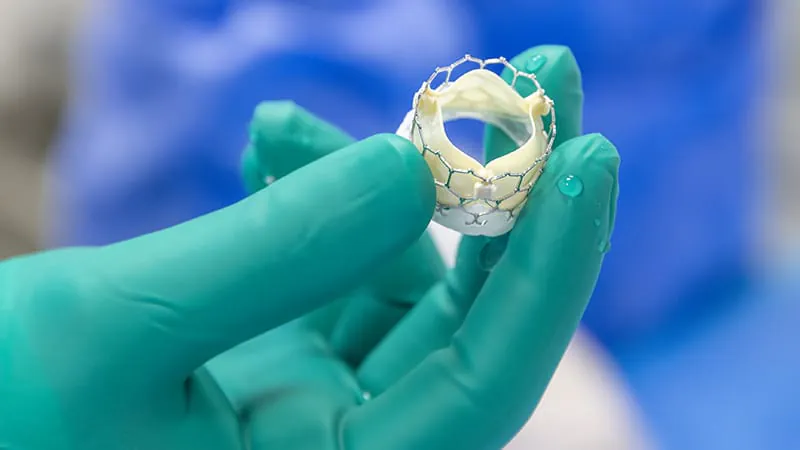
For patients — mostly women — with small aortic annuli undergoing TAVR, self-expanding valves continue to deliver superior hemodynamics at 3 years. The SMART trial shows bioprosthetic valve dysfunction was dramatically lower with Evolut vs. SAPIEN (16.3% vs. 54.4%), though no difference in major clinical events has emerged yet. Researchers expect the hemodynamic edge to translate into clinical benefits by the 5-year mark.
Three-year data from the SMART trial, presented at EuroPCR 2026, confirm that self-expanding supra-annular valves (Evolut, Medtronic) maintain a significant hemodynamic advantage over balloon-expandable intra-annular valves (SAPIEN, Edwards) in patients with small aortic annuli (≤430 mm²) — a population that is over 85% women. The trial enrolled 716 patients with a mean age of 80 years and severe symptomatic aortic stenosis.
Despite the hemodynamic edge, no statistically significant difference was found in the composite primary clinical endpoint of all-cause mortality, disabling stroke, or heart failure rehospitalization (25.4% vs. 22.6%). Investigators believe the clinical benefit is still forthcoming, with mortality curves expected to diverge beyond 3 years. A 5-year follow-up is planned. Complementing these findings, the ALL WOMEN trial — the first head-to-head TAVR device trial exclusively in women — also showed superior 30-day hemodynamics with a self-expanding valve (Allegra) vs. balloon-expandable devices.
By the Numbers:
Why it matters: With most patients in this population being women — who are historically underrepresented in valve trials — these findings carry real clinical weight. Superior hemodynamics and dramatically lower valve dysfunction rates support preferring self-expanding valves in small-annulus TAVR candidates, even before a clinical outcome benefit is confirmed.